Chessboxing: Why the Right Can't Win Debates

As this is a politically opinionated column, I tend to get three different types of response: Lefties agreeing with me, lefties respectfully disagreeing with me, and occasionally, righties who, in every single case, very obviously did not read what they are responding to except maybe part of the headline.
Something that absolutely grinds the shit out of my gears like few other behaviors is when people retort against something they have not read. When they try to appear as though they’re engaging with the piece, usually they are responding to an argument they assume is in there somewhere, or else they’re arguing something that’s already covered in the text.
This isn’t unique to the right side of politics—I’ve seen the left do it as well—but the difference is that I’ve rarely seen the right not do it.
I don’t want to simply boil this phenomenon down to “the right doesn’t read,” but it is something like that, or it has at least become something like that, and the question it raises is why is it that the right is the side that has the reputation for wanting respectful debate? The answer is very interesting: We have two completely different ideas about what debate actually is. For the right, it’s boxing. For the left, it’s chess.
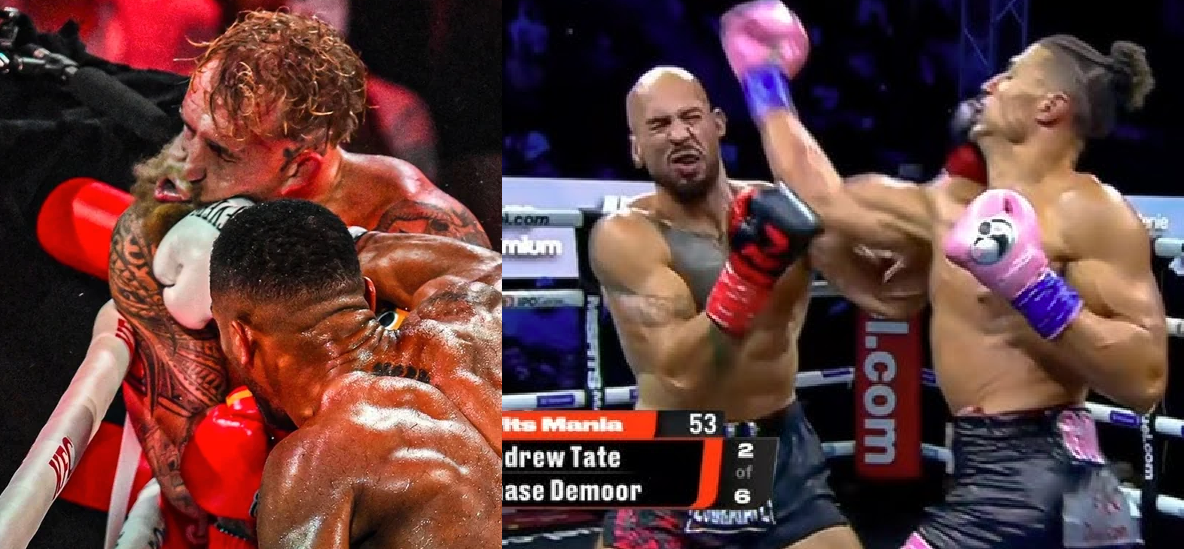
Any right winger who stumbled onto this piece stopped reading a while ago and is already headed down to the comment section, so for a while it’s just you and me, my fellow leftie. We’re going to talk about Steven Crowder and we’re going to talk about Charlie Kirk, but before that, unfortunately, we’re going to have to talk about Dave Rubin.
Rubin is popularly regarded one of the dumbest people on the American right-wing ecosystem, and that’s a competitive field when people like Chaya Raichik exist. He was recently the featured guest on one of those “Surrounded” debates, which, if you’re unfamiliar, is a web series by a group named Jubilee who take one opinionated public figure and put them in a room with 20-25 people who disagree with them. The guest debates them individually against a prominent ticking clock. I’ll drop the link at the end because it’s over one and a half hours, and if you start watching it now, you’ll get distracted by laughing and groaning at Dave Rubin and won’t come back.
Dave Rubin, to the delight of social media, really got bodied in this debate which, across three different sub-topics, is about how Woke is bad and Trump is good. Against 20 young people the episode title ostensibly labels “far-left,” he fell over himself constantly in his flailing attempts to answer simple questions, like, what Trump has done that’s actually good. After fumbling a question about the economy and inflation, he tries to switch to the topic of Trump’s tariffs, where his young opponent expertly maneuvers him, like Han Solo flying the Kessel Run, into arguing against the right-wing ideological pillar of free trade.
Some of his performances are better than others, but not because of his skill; his multiple opponents aren’t all equally charismatic or quick witted. Despite his reputation for dumbness, he is just good enough at doing something that he’s able to make a living as a public figure doing it (and it helps that he’s a token minority, as a gay man). He is no Ben Shapiro or even Jesse Watters, but he’s competent-ish. The problem he ran into, here, is that what he’s competent at was not useful in this situation.
We can laugh at him appearing dumb, which he does, but being dumber than the people he’s debating isn’t his fundamental problem. The problem is not that he brought a knife to a gun fight. His opponents, most of them, came armed with memorized statistics and numbers and facts and details. Rubin came armed with memorized talking points and memes. The problem is that he brought boxing gloves to a chess game.
It’s different to simply being bad at this. He actually misunderstands what he’s supposed to be doing. So, when the topic of the Iran War comes up, Rubin unleashes the official GOP talking point that has worked since 2003, which is that Middle East Country X needed to be attacked because they had Weapons of Mass Destruction. When the guy he’s talking to brings up some established facts to counter this, Rubin is caught off guard and needs to do a hard switch to “Islamism is bad for progressives.”
After this harrowing ordeal, Rubin slinked back to safer spaces to weep about how he had literally feared for his life the whole time.
Rubin’s disadvantage isn’t a consequence of the format. When Jubilee did an episode of the same show with the ideologues reversed—a progressive (podcaster Sam Seder) in the middle surrounded by Trump supporters—it was Seder who had all of the numbers and details memorized. His opponents slung nothing but talking points and memes that had been fed to them by the president’s communication apparatus. When Seder asked them for examples or statistics to back up their claims, they appeared puzzled that he would ask for that. Providing evidence for claims instead of just repeatedly stating them isn’t, in their mind, how this is supposed to work.
These are people who cannot debate in the way that “debate” is properly understood. They are doing something that resembles debate in the sense that bumper bowling resembles adult bowling. You’ve got the same lane, the same ball, and the same pins. However, you don’t necessarily have the same strategy. If you’re bumper bowling, all you have to do is throw the ball and you will knock down some pins. Throw it enough times and you’ll get all of them. What’s happening in these Jubilee debates is that the right-wingers don’t understand that the bumpers aren’t there.
What I’ve come to realize is that your average Trump supporter tends to believe they are the debate professionals because they have sort of been fooled into thinking that via trickery from the “thought leaders” on their own side.

What Jubilee is doing in this series capitalizes on something that Steven Crowder pioneered or at least popularized. You’ve seen this, it’s a meme. It’s literally a selection in Imgflip’s “Meme Generator.”

Crowder goes to a college campus, sets up a little stall with a cup of coffee in his hand and a smug dumbass expression on his face and invites students to approach him and argue the topic of his choosing.
But this isn’t really debate, and to be fair, I’m not sure he’s ever claimed it is. There’s no moderator, he has total editorial control, he chooses the topic, he’s allowed to have a folder of notes he researched beforehand, he chooses who gets to talk to him, and they are all very young non-professionals, primarily undergraduates.
The people who approach him might be falsely confident, but they are also foolish because there is no possible win condition for them. They have no way of knowing if the purported facts he’s written down are true or how cherry picked they are or what the counterexamples might be, or if they did happen to have a robust counter-knowledge then they have no leverage to compel him to concede that (they can’t show it to him), and if they somehow trap him into looking stupid then he has no incentive whatsoever to publish that footage.
What Crowder is doing is something that looks like a debate but is fundamentally a different type of thing. The people he tricks into stepping up to his stall are bringing chess pieces to a boxing match. It is not a skill issue. The only control you have is over how badly you lose, and if Crowder has enough footage of people losing more badly than you, then your performance will never even be seen.

This kind of content has become a large component of young people’s media diet and, along with the Trump administration’s outright refusal to answer media questions and tendency to dictate reality by gaslighting fiat, this has convinced Trump supporters that this is simply how arguments are won. You have a set of memes that are approved for use by the White House, and you say them to people until they stop talking to you. The illusion is that you have won the argument, when in reality, someone just got tired of talking to a brick wall. To both the opponent any outside observer, that person actually lost that argument.
They are confused because they think they are playing chess. It’s important here for me to clarify what I mean by chess and what I mean by boxing: Chess is how we usually define debate, which is two or more people on two sides of an issue trading facts and arguments until one side is judged to have made the more compelling argument. Boxing is arguing using repetition, browbeating, gaslighting, fallacy, talking over someone in an effort to force the discussion to conclude, and the final word wins. Like, a KO, basically.
The right, especially the far-right, can’t win at fair chess because, well, their ideas are wrong. Sorry, they just are—the facts aren’t on their side, and that’s important for genuine debate. They can win at boxing, but only if they can control the arena in such a way that the arena is actually a boxing ring, and—this is crucial—only if their opponent thinks they are playing chess.
I had already decided to call this “chessboxing” before I discovered there actually is something called chessboxing, and it has existed since the 70s apparently, and it is literally playing chess and then boxing. Who knew? Everyone except me, apparently.

Anyway, for people like Steven Crowder, who know what they’re doing, the rule is very simple: Never play chess. This isn’t because Crowder knows he’s wrong, but because he thinks proper debate is kind of something like witchcraft. It’s a subset of the right-wing belief that education is brainwashing, because education liberalizes people, it has to be brainwashing. For Crowder, college campuses are giant chessboards, and his whole project is to lure people off the chessboard and into his boxing ring, while letting them think they’re still playing chess.
Recently, JD Vance has started appearing in public more as an individual agent and less as Trump’s Mouth of Sauron, in a fairly transparent soft launch of his 2028 presidential campaign. Vance kind of fascinates me because he’s one of the few in MAGA’s inner circle who thinks that boxing is chess, so he’s kind of a Dave Rubin. He’s also comically misogynistic in a “thinks women are children” sort of way, so his recent appearance on the all-female talk show The View was a bit of a disaster. He didn’t think that women were even capable of playing chess, so he was taken by surprise when his condescending mansplaining seemed to wash up against the rocks of them Knowing Things.
Steven Crowder knows where he went wrong: He did not put himself in charge of that arena. Crowder, of course, thinks that the panel coming to this discussion prepared is a form of trickery that they played on him, and what Vance should have done, rather than try to counter their arguments chesswise with talking points, was to instead bulldoze over them with repetition and dominance. Knock them out; stop them from talking.
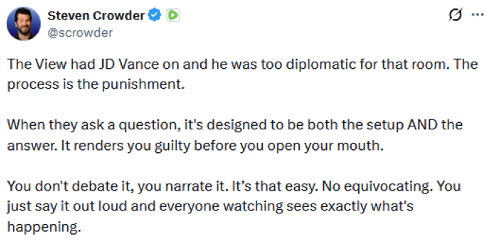
Here we come to the elephant in the room when we’re talking about college right-wing debate-me-bros. I am of course talking about the GOAT, the late, great Charlie Kirk. I think that enough time has passed… right?
Say what you will about Kirk—quietly and not within earshot of your employer, I suggest—but he was not a stupid man. He was wrong, but he wasn’t stupid, and he was definitely one of the best chessboxers I’ve ever seen. Charlie Kirk (along with Ben Shapiro, who I haven’t talked about but kind of put in the same category) is unquestionably one of the most influential figures in cementing the false idea that the right are masters of genuine debate—that they will DESTROY liberals with FACTS and LOGIC.
In fact, Jubilee’s “Surrounded” videos are a direct product of Charlie Kirk. He was the guest in its very first episode.

Kirk was primarily known for his “debates” but never put himself in a position where he would have to play actual chess. I haven’t seen all of the “Surrounded” videos, but the Kirk episode is the only one I’ve seen where the guest managed to ensure that the arena was a boxing ring. I think this mainly comes down to the fact that this was just the first episode of the show so none of the contestants knew how to prepare for it. In this sense it was very much like one of Steven Crowder’s gigs—unprepared college students with a false sense of confidence throwing themselves like kindling onto a highly prepared, though poorly argued, bonfire.
To finish up, I want to show you two clips from this episode that encapsulate what I mean about these two argument styles.
Here’s what happens when one side knows they’re in a boxing match but the other side thinks they’re playing chess—KO after KO, a massacre:
But here’s what happens when both sides understand that they are, in fact, in a boxing match:
You’ll notice that this wasn’t really a productive argument either—it was just kind of a yelling match. But you’ll also notice that Kirk kind of got beaten up, here. He bled a little bit. But, they both did.
The key to actually reviving discourse, then, is not, I don’t think, putting everyone in a boxing ring. Abandoning genuine debate for this kind of brute force sparring results in little more than a draw even if it’s the only way—satisfying though it may be—to bruise a skilled chessboxer.
The real strategy, I think, is to learn how to tell whether the debate you’re getting into is a chess game or a boxing match. If it’s the latter, just walk away. Or better yet, if you’re on social media, the block button is free. If you try to chessbox me in the comments I will deal with you likewise.
If you’ve got some hours to waste, here’s the full “Surrounded” episodes for:
So hey, I'm writing a book about toxic masculinity, online culture, and how it all led to Trump. The working title is How Geeks Ate the World and if you like this newsletter then you'll probably like my book. If you're unsure, the good news is I’m going to be dropping parts of the draft into this very newsletter as the project comes along—but only for paid subscribers. So if you want to read along in real time, please consider subscribing. Otherwise I’ll be keeping you in the loop. Check it out here: