How Memes Stalled Western Culture
Here’s a video that explains a lot about what’s wrong with culture at the moment:
This is doing the rounds on Twitter, and it’s an AI-generated (like most visual media on Twitter and Facebook) video of the characters from Seinfeld interacting with characters from other 90s and 80s franchises. “I love you,” Princess Leia tells a shirtless George Costanza in the bed they are sharing. “I know,” he replies, followed by a string of Costanzean quips in a flawless generative mimicry of Jason Alexander’s voice.
This isn’t just about AI. In this case, AI isn’t the source of the problem. It’s merely an enabler. It’s making it easier than ever before in history for us to satisfy an urge that our brains seem weirdly addicted to: Cultural recursion.
Did you notice that we stopped changing our clothes as soon as the internet arrived? People in the 50s looked completely different to people in the 60s. It was different again in the 70s and different again in the 80s. Land in any given decade of the 20th century and a photo of someone in either direction would look like an alien. Then the internet arrived. If you’re under 40, you haven’t seen a meaningful change in the dominant mainstream fashion in your entire life.
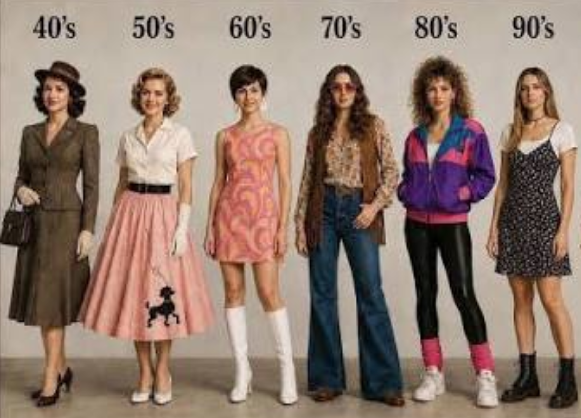
There are always those who want to flaunt their individuality but looking stylish in the 2000s wasn’t about innovation. It was about mashups and it was about retro. Mixing and matching the present with the past. Rockabilly with sleeve tattoos. Creative, yes, but more recursive.
1999 is regarded by many people to have been one of the greatest years for American mainstream cinema. This is the year The Matrix was released. It also gave us The Sixth Sense, The Mummy, The Blair Witch Project, Payback, Office Space, Cruel Intentions, 10 Things I Hate About You, American Pie, Eyes Wide Shut, Deep Blue Sea, Runaway Bride, The Iron Giant, Mystery Men, The Thomas Crown Affair, Double Jeopardy, American Beauty, Three Kings, Bicentennial Man, Girl Interrupted, Any Given Sunday, Dogma, Galaxy Quest, The Green Mile, Magnolia, and Fight Club.
But the most anticipated movie of that year, by far, was Star Wars Episode 1: The Phantom Menace. It was very unusual for the most successful movie of the year to be a sequel or a franchise. Usually the biggest movies were summer blockbusters with original scripts.
Later this year, Robert Downey Jr will return as Doctor Doom in Avengers: Doomsday. A different character played by Downey was killed off in the previous Avengers movie, but fans couldn’t let him go.
Also returning is Chris Evans as Captain America, a character who was written out of the story in the previous Avengers movie via a one-way time travel gimmick, but fans couldn’t let him go.
Also returning are Patrick Stewart, Ian McKellen, Kelsey Grammer, Alan Cumming, James Marsden, and Rebecca Romijin as the X-Men. They don’t belong to this franchise or even the studio that’s producing Avengers: Doomsday, and some of them did not survive the previous movie they were in, but fans couldn’t let them go.
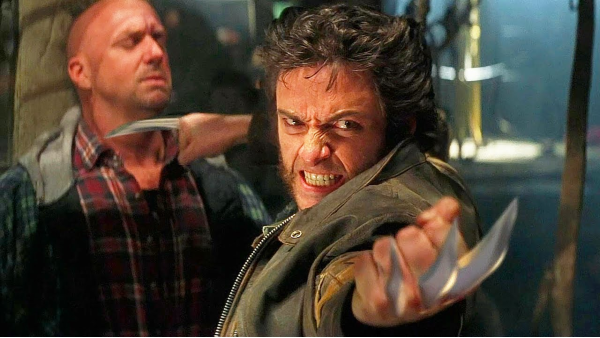
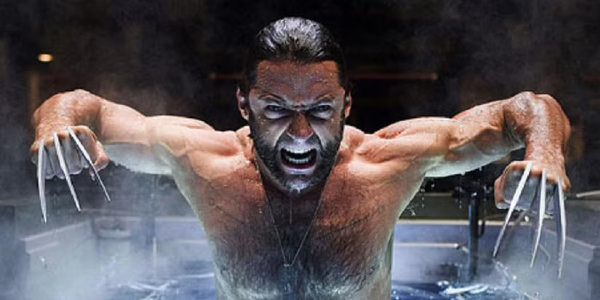
Almost certainly returning is Hugh Jackman as Wolverine. Don’t play coy with me, you know he’s going to be in this fucking movie.
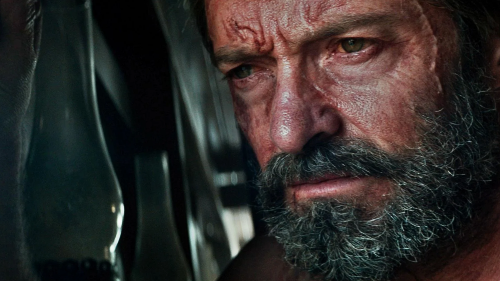
Every year that one of these lumbering behemoths of a movie comes out, social media turns into a rolling feed of all the characters you think you might remember from previous movies and wouldn’t have noticed if they never came back but now you know you can’t do without them.
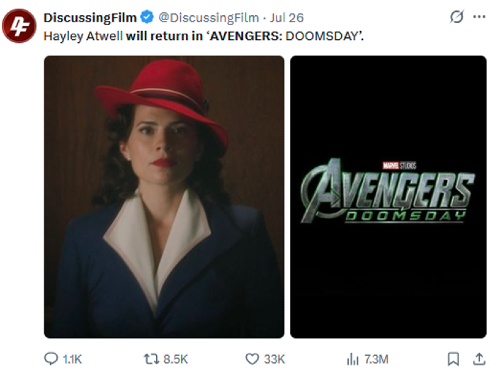
Characters from one franchise interacting with characters from another franchise isn’t something Marvel invented and it’s not even a recent invention. Freddy vs Jason and Alien vs Predator are just the Millennial revival of a gimmick that began when Abbott and Costello met Frankenstein in 1948. But man is it on overdrive at the moment. In 2023, DC studio tried to one-up Marvel’s current nostalgia-maxxing model with The Flash, a movie that tapped not only into nostalgia for old movies, but also nostalgia for movies that were once in development but fell through. In it, Barry Allen’s Flash teams up with the Michael Keaton version of Batman from Tim Burton’s 1989 film, but also later meets a Superman played by Nicolas Cage from a cancelled 1998 movie that was also going to be directed by Burton.
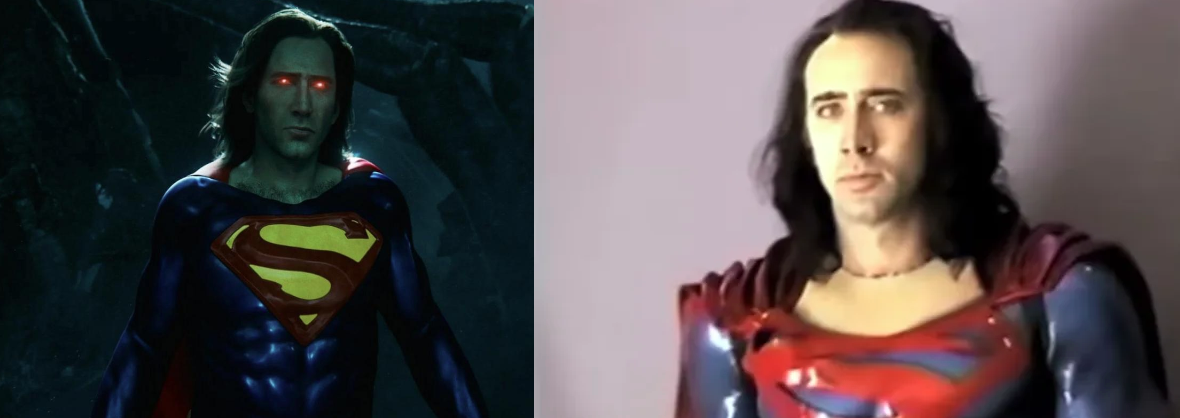
Burton’s Nic Cage Superman exists now as a meme, from various photos of him in costume, and also a famous anecdote by the movie’s screenwriter, Kevin Smith, in which he recounts being heavily pressured by the studio to include Superman fighting a giant spider in the climax. This battle is also portrayed in The Flash.
I’m far from the first person to complain that every movie is a sequel or part of an existing IP these days, but I don’t know that there’s ever been a convincing explanation for why that is. I don’t know if there’s been a convincing explanation for why we’re wearing the same clothes today that we were wearing to the Phantom Menace premiere. I do suspect that it’s not a coincidence that culture began to get really recursive when we started feeding it all into this box on our desks.
Here's what paid subscribers are reading right now:
Culture has been coming out of a box for some time. Television was such a threat in the 1950s, in the eyes of Ray Bradbury, that he wrote Fahrenheit 451 about a future in which everyone’s attention span has been fried and they burn all the books they no longer have the literacy to read. But while television did feed culture back to us it also led it to some extent. It did not turn our brains to pudding the way so many feared that it would.
The internet is not on a programming schedule. You don’t need to open a newspaper to see what’s on the internet this week. We just log on and dump ourselves onto it. And let me be clear—a great deal of high-quality cultural content has come out of the internet, particularly in its earliest years. But it also led to memes. People making the same references, over and over. There is comfort in familiarity. Like an inside joke—seeing something you recognize makes you feel like part of the in-crowd. It’s like a secret handshake.
There is a little bit of an addiction component to memes. It’s not exactly opium but it does give you a little hit. A little bumper. A bit of your brain lights up just because you saw something you recognize from an earlier time when you saw it. In our lizard brain it’s pattern recognition. As pack animals we love to see the markers of our tribe, and the markers of our tribe are George Costanza and Hugh Jackman as Wolverine.
Television gave us the things we wanted to watch, but it also gave us the opportunity to stumble on something new. The internet’s great innovation is the algorithm, whose sole purpose is to greatly reduce your chances of stumbling on something new. You feed culture into the box, it beep-boops, and it feeds that same content back to you. It weeds out the stuff you haven’t told it that you enjoy seeing. It is endlessly recursive. It feeds you back to you.
When people say that social media is addictive, I think that’s probably the mechanism through which it hooks you. If tribal familiarity is itself a little addictive, then what is an endless ocean of algorithmically sorted familiarity? Might you even become a little hostile to the idea of seeing something new?
Former Whitest Kids U Know troupe member turned acclaimed horror auteur Zach Cregger recently released a newie you might recognize: Resident Evil. It is a movie based on a video game franchise in which a pharmaceutical company accidentally releases a virus that turns its victims into zombies that also sometimes have tentacles and stuff. I probably don’t need to explain this to you, as captive members of our recursive culture. Cregger is a big fan of the video games, but he is also a serious filmmaker. When given the opportunity to helm a Resident Evil movie, he opted not to follow the main characters from the games, who are Special Forces agents, and instead tell an original story about a new character, a civilian, who is dropped unarmed and unprepared into this boiling morass of undead octopus zombies.
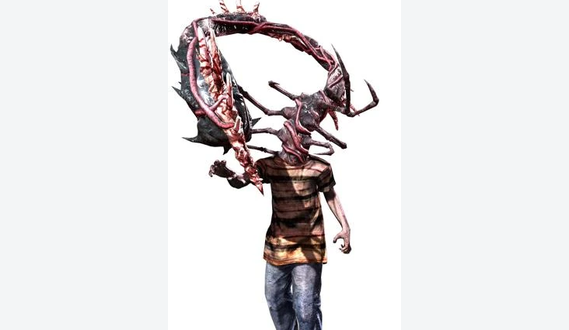
The social media response from the fans of the games was immediately apoplectic with vitriol and death threats, the currency of internet fandom. They didn’t want a new story. They’d played the games over and over again and could likely still play them whenever they wanted, but they still wanted that shot-for-shot story playing in the cinema for them, again. They were afraid they wouldn’t see the zombie dog from the 1996 Playstation game Resident Evil and so couldn’t turn to the person sitting next to them and whisper “that is the zombie dog from the 1996 Playstation game Resident Evil.”
The backlash was so intense and annoying and, probably, hurtful to Cregger, a true fan, that he wound up defending his choices so much in the lead up to release that he felt like he was on “an apology tour” and vowed never to make another franchise film. This was, I reiterate, before anyone had seen the movie.
Now, if algorithms are in fact to blame for some amount of this recursive culture, then what do you think generative AI is going to do? Its entire thing is that it has absorbed the totality of our culture and learned from it in order to spit those images back out at us in different configurations. We no longer need the algorithms to feed familiarity back to us. We can generate our own familiarity at will. We can even generate novelty within familiarity so that we can see something fresh without ever seeing something new. We can make new Seinfeld episodes in which they meet Frasier Crane and Rachel Green and Hugh Jackman’s Wolverine.
I’m not sure that too many actors such as those in the Seinfeld cast have been asked to weigh in to give their opinions about this kind of social media content. Certainly the Screen Actors Guild have been working hard to protect SAG members from predatory AI use, but that doesn't cover your average schmo getting on Twitter and asking Grok to generate a realistic video of Morgan Freeman firmly denying the Holocaust in his distinctive voice.
But the horrors of the coming identity theft apocalypse aside, it’s fairly dismaying but also predictable and more than a little ominous that, after being promised that generative AI would bring forth an explosive new era of creativity, we are about two years into this and still every new AI-generated film on social media looks like this:
Endless cultural recursion. The same images, repeated over and over again. Memes meeting each other. Characters from the 90s riffing off characters from the 80s. The content of the internet is increasingly AI-generated recursive output of recycled already-existing content. We put our culture in the box, we shake the box, the box pumps out the same culture in different arrangements. We put that back in the box, shake it. How many different arrangements of the same thing can there be? Possibly nearly infinite. The number of possible chess games is a number with something like 120 digits, which is a lot of novel familiarity for a game with 32 characters. Every one of those games looks like chess, though.
How many quips can George Costanza throw at a slate of television characters from 1980 to 2010? That number probably also has hundreds of digits. It’s still not a novel culture. It’s endlessly recursive.
I don’t think our culture is doomed. Zach Cregger’s Resident Evil is actually smashing the box office despite the haters because not everyone is terminally online and a lot of people still react positively to originality. There are signs that culture is coming back from a recursive death spiral with a bunch of great new artists injecting novelty into it and finding success in a society that’s beginning to feel cultural starvation. After all, you can’t survive forever on a drug. Eventually you need some nutrition.
Until we recover, we may need to put up a while longer with stuff like “Jason Alexander will return as George Costanza in Avengers: Serenity Now.”
I'm writing a book about right-wing reactionary movements in tech and geek culture in general. The working title is How Geeks Ate the World and if you like this newsletter then you'll probably like my book. I've been dropping parts of the draft as the project comes along—but only for paid subscribers. You can check it out here: