🔒 How We're All Losing Our Grip on Reality
So Senator Mitch McConnell is alive, for better or worse. The heart attack with his name on it missed and clipped Lindsey Graham’s aorta. At least that’s the official story. The internet remains largely unconvinced—not that Graham is dead, which seems pretty incontrovertible, but rumors of McConnell’s death stubbornly persist.
This despite a selfie that he posted of himself and his wife in the hospital, looking right as rain, and holding up a copy of that day’s newspaper in a subtle nod of acknowledgment that this proof of life was going to require some extra weight.
Folks aren’t buying it. AI can do this now!
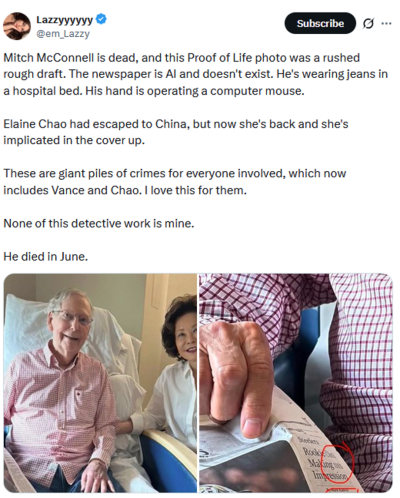
As social media detectives will tell you, this isn’t even good AI. It’s riddled with errors. Jeans in a hospital? And look how weird his hand looks!
While I concede that AI probably can do this now, I am not so cynical as to believe that’s what this is. There are too many other elements to the conspiracy theory for it to be plausible (not the least of which is that they would have to concede that he’s dead eventually) and there are no suspicions about the photo that don’t have a perfectly reasonable explanation. But if you look over social media, the AI photo hoax looks like the dominant narrative. And folks, this is our lives now. This is the new normal.
Plenty of people are having fun with this, and generating obviously fake videos of McConnell getting out of bed and dancing around or throwing his wife out a window or morphing into a turtle or whatever. I stopped finding AI fun in any way quite a while ago. But a lot of people, I don’t want to say most, seem somewhere on the spectrum between ‘suspicion beyond what’s healthy’ and ‘staunch rejection of the evidence.’
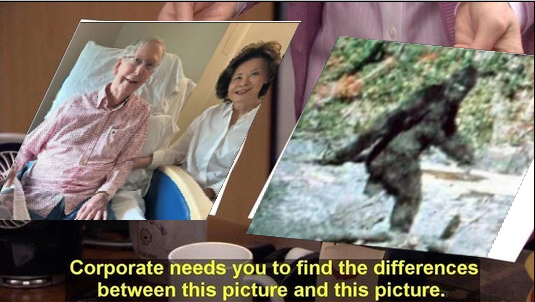
And believe me, I know very well that this isn’t a new phenomenon. Before AI image generation, conspiracy theorists would say that images were photoshopped. Before that, they would say that body doubles were used, or lookalikes, or clones. Motivated reasoning and the desire to manufacture evidence of what you’ve already decided to believe are tendencies as old as humanity, and AI is just another enabler.
But man, I’ve been debunking conspiracy theories for a long time and haven’t seen anything on this scale before. We are, all of us, quickly losing the ability to grasp what’s even real. Normal people have already left the building. Experts remain who can still tell, but the AI companies are breaking them down.
The assault is coming from two sides: Those who object to AI but over-diagnose its presence in everything they see online, and disinformation agents who actually use AI to either bolster their argument or troll the discourse and maliciously poison the entire discussion. For fun, I suppose.
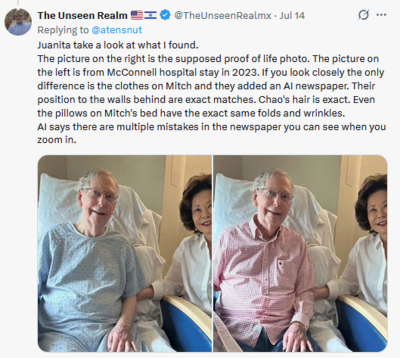
What distinguishes this from your everyday conspiracy theory mindset is that people who are not ordinarily like this have trapped themselves into a situation where they obsess over the various “tells” of an AI-generated image, inspecting every minutia, to the point where actual snapshots of genuine reality now seem strange—the position of a hand; the way fabric falls; a texture that doesn’t seem right.
Conspiracy theory is not, in itself, the product of some mental illness. It is very much part of our humanity. We all want to be unique. We all want to be the one who figures stuff out. The first person to come up with a theory about how 9/11 was staged wanted to tell the world what he thought he’d discovered. He wanted to be the one who cracked it. AI hoax detectives are no different in their motivation. When everyone else is falling for the bait, you want to show them the abnormalities—the weird fingers, the weird expressions, the things the machine didn’t quite get right but you spotted it.
The ubiquity of AI is tapping into this urge deep inside all of us and touching it in more of us than ever before. When we suspect foul play, we will search for evidence, and when we search, we will usually find it, even if we have to massage reality for it to become clear to us.
For free subscribers, this is a preview. Free subscribers get access to this article on Friday 24-July