🔒 How White People Stole The Odyssey
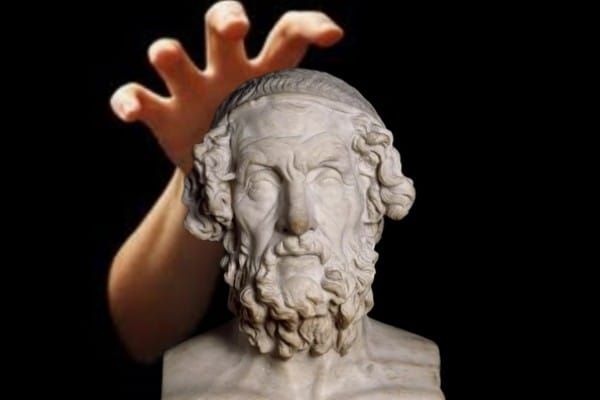
I’m sorry to talk about The Odyssey again, but the scale of the right’s crash out is something to truly behold. During the height of the scandal I suppose we’ll have to call “Lupita Nyong’ate,” every far-right personality from Elon Musk down to your average comment section troll was betting everything on this movie flopping at the box office.
Their absolute certainty that a major fantasy epic with an A-list ensemble directed by one of the most acclaimed filmmakers of the 21st century, who was fucking knighted for his previous film that also won 7 Oscars including 4 of the Big 7, would utterly fail was based on one singular gambit: that audiences in the age of Donald Trump would object, to the point of boycott, a movie based on Greek myth that featured a partially multi-racial cast, as well as one white transgender actor.

They lost that gambit. The Odyssey has the box office on the ground begging audiences for mercy to ease up on the combat-strength money hose they’re firing at it, and the critics are forced to fall back on wild conspiracy theories about how Rotten Tomatoes is faking the audience score, or cinemas are faking ticket sales, or that the idea that a movie earning over a billion dollars makes it successful rather than a catastrophic failure is some sort of Hollywood accounting illusion.
But whether they foolishly deny or begrudgingly accept that people are, in fact, both watching and enjoying this movie, the anti-wokeness crusaders nevertheless remain insistent that their complaints about the casting are not racist. They’ll say “You wouldn’t cast a white actor as Black Panther” or “You wouldn’t make a MLK biopic starring Ryan Gosling.” You can counter by explaining that there are explicit artistic decisions for the casting of these characters, but then they will immediately hit you with this piece of Twitter copypasta as swiftly as pulling out an Uno Reverse card:

And you know what, let’s steelman the anti-woke race-casting side to examine how they really are kind-of-sort-of lying about their true objections.
This should go without saying, but I have no issue with people who don’t like this movie for good-faith reasons, because, I mean, you’re allowed to not like something. I just saw it this week and thought it was good but not great. The biggest let down was the dialogue, and I don’t mean the American accents—that didn’t bother me at all—I mean Nolan’s penchant for making characters explain the theme of the movie to each other in a way that’s too clear that they’re actually explaining it to you. (How many times, in a movie set during the Bronze Age collapse, does a character need to say to another character “The Bronze Age is collapsing”? More than a few, according to Nolan.)
Strictly on the subject of racial casting, though, the arguments against The Odyssey are dishonest bullshit.
First of all, these goalposts are on wheels. I’ve seen multiple people online ride the “historical authenticity” line of argument to its absolute conclusion: Not only should all the actors be Greek, but the dialogue should be spoken entirely in the 9th Century BC Northwest Doric dialect of ancient Ithaca. Subtitled, presumably. Or maybe not—maybe the audience should take it on themselves to learn the language in order to properly honor Homer.
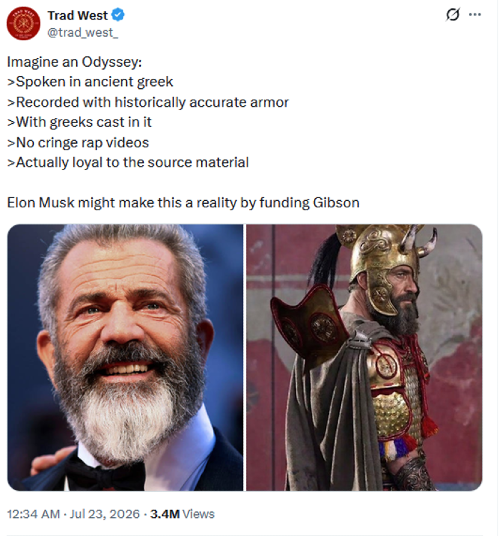
It quickly becomes clear that this is a super disingenuous and post hoc rationalization about the specific complaint they have but can’t say outright. Consider that many of the same people lambasting this film for deviating from the story and not being cast with Greek people speaking authentic Doric have also suddenly discovered a newfound love for a 2004 Wolfgang Petersen flop called Troy.
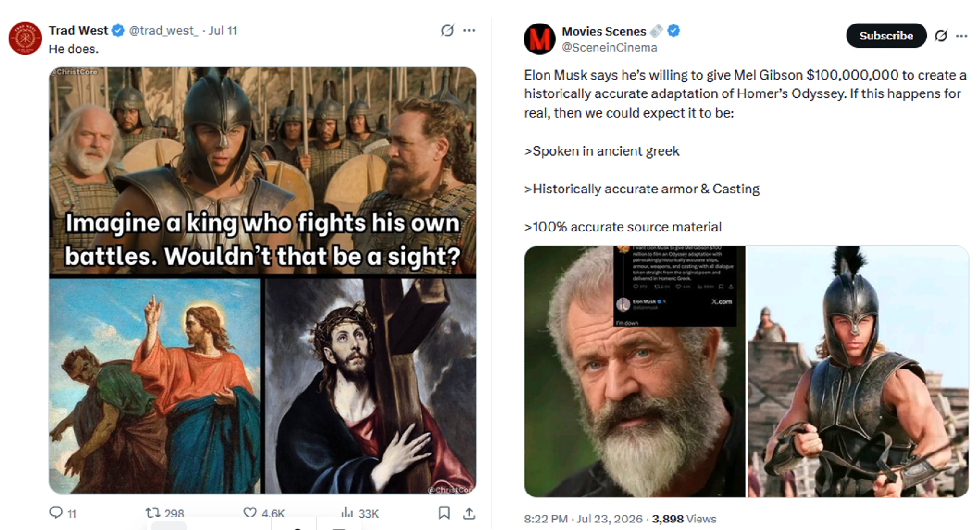
Troy is based on The Iliad, the story to which The Odyssey can roughly be considered a sequel. It’s an okay effort by a decent director to revive the sword-and-sandal genre. It’s also an absolutely terrible adaptation of The Iliad. Nobody who nitpicks minutiae of Nolan’s retooling of the timeline of Odysseus’ journey gets to praise Troy for reducing the famously, importantly, prolonged, stalemated, ten-year Trojan Forever War to a five-day skirmish.
They don’t speak Greek, they speak Queen’s Latin—a type of mildly British-accented English dialect invented for sword-and-sandal films.
Nobody has a problem with any of this. Nobody is petitioning Mel Gibson to come in and do a Mycenaean mulligan on Wolfgang Petersen’s largely forgotten attempt to cash in on the early 2000s Lord of the Rings cinema craze. You know what they absolutely love about Troy? It’s this:
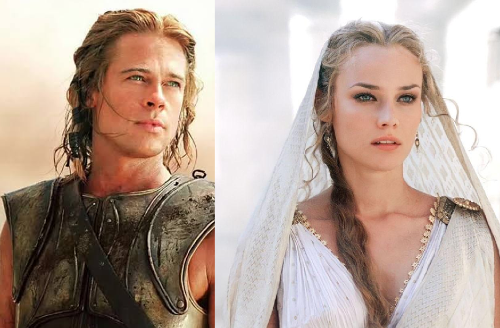
The gods are Aryan.
Not every actor in Troy is blonde and blue-eyed, but the closer they are to divinity, the more this is emphasized. Helen of Troy, the daughter of Zeus, is played by German actress and model Diane Kruger. Achilles, the half-nymph quarter-demigod epic hero of Greece is played by Brad Pitt, a white American actor whose ancestry is Scots-Irish, German, and Dutch. Investigate further afield to the other, darker-haired main cast members and you still find mostly Irish, Scottish, English, German, and Scandinavian. The geographically Greekest cast member, Eric Bana, a white Aussie, is German and Croatian—his real last name is “Banadinović.”
The point is that most of the actors in this movie trace their ancestry to Northern European countries that are further from Greece than Ithaca is from Troy. This should bother cinematic Homer purists if they were actually being honest about what they want.
Of course they move the goalposts here and say that the truly important thing is that the actors are all European or of European descent. And hell, maybe diversity is positive here as long as it’s European diversity, because this story belongs to Europeans. So it would be okay to have a mix of Greeks, Italians, Scots, Germans, maybe get really spicy and cast someone Slavic. But when they get to propose their own fantasy casting, you know which ethnic group is going to be cast as the best Europeans. The ones descended from Olympus.
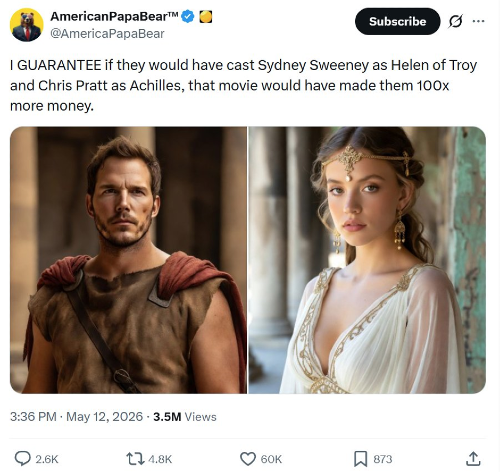
In actuality, what bothers casting critics about Nolan’s Odyssey isn’t its faithfulness to Homer, nor to Greek culture, nor even to Western culture. This is a skirmish over whiteness, and, paradoxically, when it comes to the question of “who is white,” the Greeks don’t quite make the cut, although we’re rather happy to take elements of their mythology and bleach-blonde them until they are acceptably Nordic.
For free subscribers, this is a preview. Free subscribers get access to this article on Friday 31-July