Parasocial Media: How We Became a World of Influencers
On the now quite rare occasion that I scroll through my Facebook feed, I see a hell of a lot of this one guy:
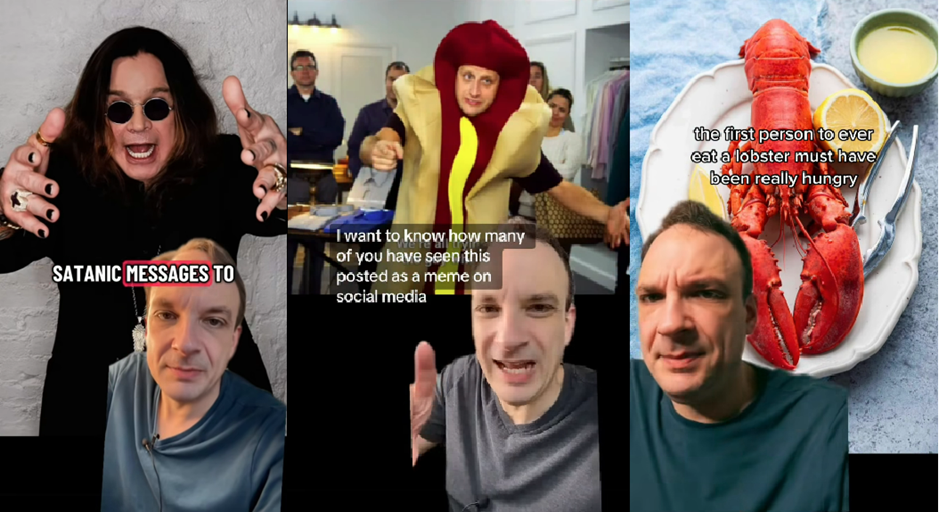
That’s Jason Pargin, my old boss, who is now a prominent TikTok/Reels influencer. We haven’t spoken in nearly a decade, but Facebook spams me with his videos because I do tend to watch them, and that trains the algorithm, so this is all it shows me now.
He does a great job. This is also the absolute last thing I could ever have imagined him doing with his life when we parted ways in 2018, during the fall of Cracked.com which saw the termination of my contract plus those of dozens of writers much, much more talented than myself. Jason played no role in those layoffs, understand, except for how hard he fought for us. Now he does this instead. And you need to know just how crazy that is, how private this man is: I probably knew him about ten years before I knew what his real name was, and it was longer than that before I knew what he looked like. He’s not doing this because he wants to, he’s doing it because he has to.
Jason is a novelist now, but he can’t do that unless he does this. Hear him explain it in his own words:
The idea that we are living in a “world of influencers” goes deeper than what he explores, here. Cracked was a long-form comedy and infotainment website that ruled the internet briefly in the late 2000s/early 2010s just before social media came along to kill it. You can’t really have a website like that, now. Cracked still exists, but it’s largely a social media aggregator, regurgitating funny tweets and Instagram posts and Reddit threads. There’s a reason for that.
Social media and algorithms did this to us. They trapped us all on these apps and locked us into a constant battle for attention. Suddenly the internet became so noisy. There is too much to consume. Have you noticed that writers and artists of any type are now called “content creators?” All creative output of any kind has become part of a single mass that we call content. We flit between one piece of content and another, consuming it quickly in nibbles. Any creator capable of drawing more than just a nibble of their content—even so much as a bite—is called an influencer. They can influence the ripples and the tides of the mass.
You can’t do that from behind a keyboard. Or you can, but it’s extraordinarily difficult. The days of creating art that your audience gets to enjoy for its own sake, without feeling like they know you personally, are finished, because folks don’t subscribe to works, anymore. They subscribe to people.
The traditional route to success as a writer is in a state of decay and those who want it dead, sensing weakness, are moving to hasten its destruction. It once was that a writer could join some sort of media institution and be paid for their talent, but as soon as that business model began to falter, as soon as its shields were down, the Borg army of right-wing capital marched in to assimilate and bring it to heel, to dismantle any capacity it had to question power.
Rupert Murdoch was the first ghoul to start rounding up the media, but then billionaires like Jeff Bezos and Elon Musk started doing it. Trump loyalist David Ellison is currently acting like The Matrix’s Agent Smith, ramming his hand through journalists’ chests and cloning himself. He bought Paramount last year, which gave him CBS, and now he’s bought Warner Bros, which gives him CNN, HBO, TNT, and Batman. Recently, Trump’s FCC chair Brendan Carr vetoed an anti-monopoly law that would have prevented Trump loyalist media company Nextar from taking over Tegna, which will give it 265 television stations.
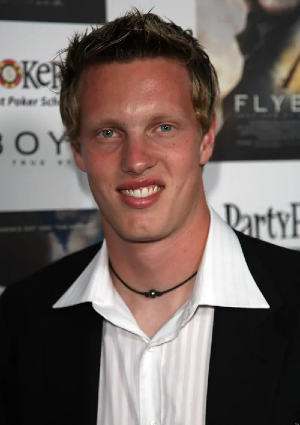
Around the same time that Jason put out the above video, I listened to a podcast episode by two other former Cracked alumni, Daniel O’Brien and Soren Bowie, who now do a YouTube show that I listen to at work. They’re both successful, but work for the aforementioned vulnerable media conglomerates. Daniel is a senior writer for John Oliver’s Last Week Tonight, and Soren is a writer for Seth MacFarlane’s American Dad.
What happened to all of us at Cracked was the same brutal business reality that John Oliver and his staff, including Daniel, need to contend with as their parent company—Warner Bros—is looking down the barrel of the Ellison takeover. They’re all acutely aware of what happened to Stephen Colbert five minutes after Ellison ate Paramount.
As the business oligarchs consume the western world, they are turning the remaining aspects of our lives that aren’t work into work. Not just creative endeavor, but also casual relaxation are being converted into the duel states of capitalism: Hustle, and consumption.
Here's what paid subscribers are reading right now:
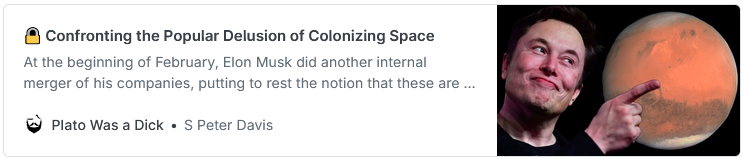
It was smuggled in. We didn’t know Facebook was a Trojan horse. I remember back around 2010 when I first signed up—we all did—and Facebook was just a scrolling feed of whatever your friends were talking about. Now you don’t see your friends at all. You see a global and algorithmically selected stream of content that Facebook’s ever more sophisticated artificial intelligence has determined that you will enjoy. Whatever my friends are posting, it has decided, is far from the most interesting content available in the world, and I will be better served by a selection of content that it curates for me.
Now my feed is just Jason Pargin’s videos, plus a different guy reacting to other videos of food preparation (who I can tell somehow, even with the sound off, is both British and gay), plus countless ads for a knife sharpener I accidentally watched all the way through once, plus AI-generated nonsense, plus photos of random women with an OnlyFans link in their bio. I never see the ordinary guys I knew casually in high school anymore, who I didn’t really speak to but enjoyed watching them grow older and raise families.
I mourn the loss of a feed of ordinary people I was friends or acquainted with posting and joking about ordinary things. The mandate set by the tech companies that now rule our online lives is that your so-called friends aren’t hustling enough for your attention. Facebook, as well as social media platforms in general, have decided that the era of casual friendship is finished, at least online, and has been supplanted by the era of parasocial relationships with influencers.
2026 is the year I have decided to start dabbling in fiction again. I’ve been going to conventions and workshops. Nobody is happy about it, but if you’re a first timer seeking to get published, one of the most important things to have is an Instagram account. A popular Instagram account. I haven’t been going to any self-promotional sessions—I have no drafts anywhere near that far along—but I wonder if they have started teaching people how to “post.”
That’s the engine of the creative economy in the parasocial media age. The journalists and columnists who survived the traditional media collapse preempted it by becoming early adopters of Twitter, posting frequently and not just about their work. Mostly not about their work, in fact. Establishing that illusion of a personal bond. This is how they were able to scramble onto the lifeboat of independent media when the Titanic of traditional media struck the iceberg of the internet.
Social media is capable of producing at scale the kind of parasocial mental state previously suffered only by people like John Hinckley, Jr. That is, the feeling that you have something of a personal friendship with, or at least connection to, a celebrity, or these days, an influencer. Jason Pargin telling you interesting facts in your Facebook feed feels more personal, somehow, than, say, Jeff Goldblum telling you the same facts on a Disney Channel documentary.
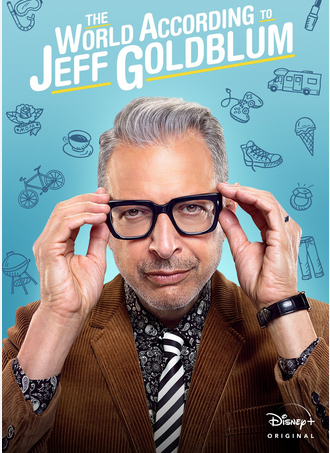
I don’t know what it is that causes this effect, but it has been revolutionary on the scale that it has radically changed the way that people regard and consume what used to be called art or media but is now called content. Maybe it’s simply the presence of comments and replies that creates the illusion of a two-way interaction. Some influencers interact directly with their audience, but most don’t. Jason once did, but no longer does, probably because he’s noticed it makes no difference. He will frequently end a video with a question and an invitation to “let me know in the comments,” as though he’s reading them.
I sincerely don’t want to undercut Jason’s strategy here, but when you compare the size of our audiences, I feel safe in confiding to you that we had a mantra at Cracked: “For your mental health, never read the comments.” I doubt that’s changed.
Here’s the depressing band-aid that I need to rip off: Old hats in the industry are likely to describe social media as a tool to promote your work. That might be true for some long-established household names, but for people entering creative fields in the 21st century, increasingly, posting is the work. Jason’s work as an influencer began as promotion for his novels, but it is now overwhelmingly his full-time job, so much that he barely has time to write the actual books.
For many, posting isn’t just the primary work, but it has become the only work. On platforms like YouTube and Twitter, and I’m not sure which others, users are paid by the view. Most influencers are not promoting anything; they’re just racking up clicks. Writing a book or something like that would get in the way of the much more lucrative work of being an influencer.
In the social media age, the only thing that’s left to sell is yourself. If you’ve written a book, the book you’ve written isn’t your primary work. Your book is merch.
It’s not much different to that energy drink that Logan Paul sells. Most people who drink Prime Energy don’t do it because they love the product, and for all I know it could be a great product, but they drink it primarily because they want to support Logan Paul. For some reason.
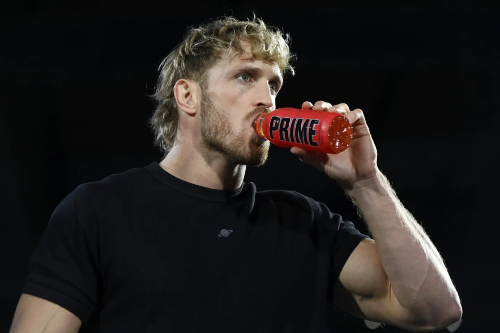
If you’re a serious creator, of course, the profitability of what you consider to be your primary body of work isn’t anywhere near as important as sharing it with people. That’s the huge difference between a writer-influencer’s novel and Logan Paul’s stupid energy drink, even if there’s little practical difference—I don’t think Paul considers his drink to be his opus.
As creators who consider our craft to be more than simply “content” (which I consider to be the most offensive normalized term in professional work since “human resources,”) we unfortunately cannot afford to ignore social media posting and parasocial marketing as vastly the most effective way to get eyes on our work. And yes, we must constantly remember and find a way to reconcile that these platforms are evil and the people running them are largely responsible for forcing us to do things this way.
This is something I feel a large and loud portion of people on platforms like Bluesky don’t grasp when they don’t understand why writers and other creatives won’t leave Twitter and Substack “because they’re infested with Nazis.” The ad hominem usually goes that people who stay on those platforms are so wretchedly narcissistic that there is no moral imperative powerful enough to persuade them to let go of Big Number Follower Count.
I have no shortage of criticism of how Substack conducts its business, I raked them over the coals again just the other week, but the fact is that some of us aren’t universally great at posting interchangeably to any platform’s audience. Abandoning Big Number Follower Count often means deciding to end your entire career as a creator and thus, ironically, consciously shutting down the small amount of power you might have had to fight back against these platforms. If you move your newsletter to Ghost or Beehiiv then you will do great if your content and influencer skill is fine tuned to Bluesky’s largely rather specific audience. If not, hello call center career.
The fact is, I am terrible at posting. On microblogs I am a “reply guy,” which is a derogatory term for someone who replies to posts more often than they post, themselves (considered the lowliest creature on the internet, in the era of the influencer.) I can’t tweet (or “skeet,” as Bluesky’s community has unfortunately chosen to call it) very well at all. I have both an Instagram and a TikTok account and have absolutely no idea what to do with either of them.
But here’s the most popular thing I’ve written since my time with Cracked ended, and by no small margin:
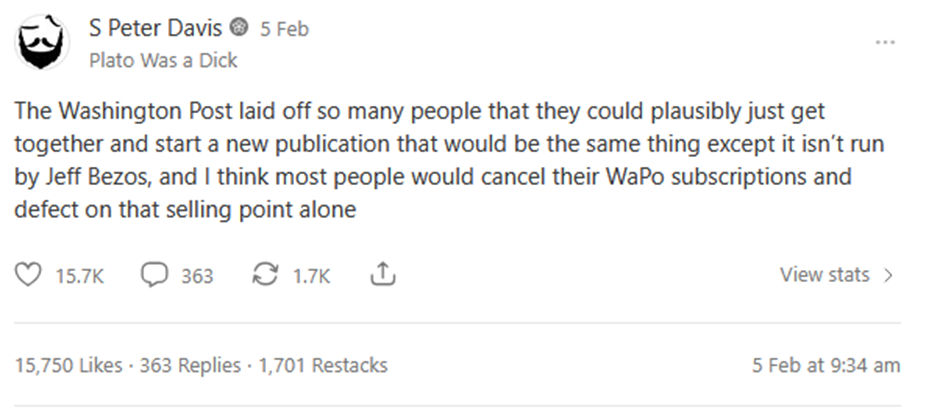
This isn’t a newsletter or an article, it’s a post, which I posted to Substack’s Notes social media platform. To be clear, this wasn’t even a serious post, it was kind of a joke. There’s much more to starting a media company than a bunch of people coming together to form Journalism Voltron. But I’ve never seen an actual newsletter do these numbers on the actual newsletter platform. I tapped into something here, I moved the needle in a way that is rare for me, I motivated people and excited them and inspired them. I influenced them. Even if the post is kind of nonsense, it broke through the noise.
Like it or not (I don’t) this is the model we have been foisted into, and it’s what we need to work with. Maybe, with a lot of work and unity, we can influence ourselves out of it. Until then, please like and subscribe and leave your comments below. (I promise, despite my Cracked-era advice, I do read all of your comments and even try to respond to them.)
I'm also writing a book, which I'm hoping to publish and sell via audience interest from this very newsletter. I'll never be much of an influencer, but I hope I can get part of the way there. The working title is How Geeks Ate the World and if you like this newsletter then you'll probably like my book. If you're unsure, the good news is I’m going to be dropping parts of the draft into this very newsletter as the project comes along—but only for paid subscribers. A new chapter is coming out this very weekend! So if you want to read along in real time, please consider subscribing. Otherwise I’ll be keeping you in the loop. Check it out here:

Here's what paid subscribers are reading right now: