The Internet is An Ever Expanding Graveyard
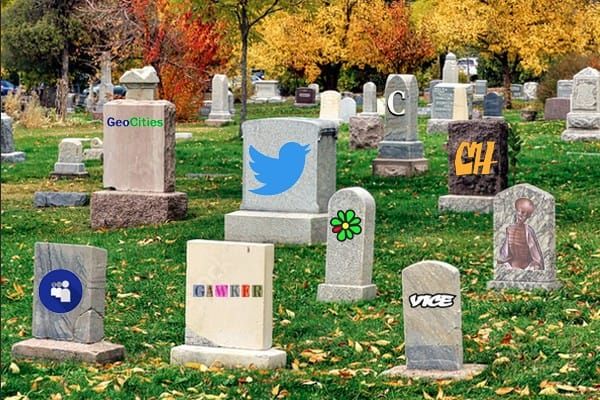
Something has been bothering me for a little while now. It was exacerbated recently by a short essay by Dave Karpf about the fact that Bluesky isn’t taking off. Like, at all.
And I know a lot of you are going to say “Well, of course it’s not taking off, it’s just ultra-woke Twitter. Most people who aren't interested in fighting about whether left-handed sporks are ableist just stayed on Twitter.” But that’s just the thing—Twitter is in rapid decline as well. Social media is starting to collapse like a dilapidated structure. Yes, when Elon Musk broke the political emulsion, the left went largely to Bluesky and Threads and the right (and those prepared to tolerate it) stayed on Twitter. But most people left and went nowhere.
As Karpf theorizes, they went to chatbots. And they might never come back.
Of course, the people who are easily able to wave goodbye to social media are likely the people who didn’t need it much in the first place and meet all of their social needs by, you know, hanging out with people. There’s no reason to believe that Twitter’s estranged children are spending all their time chatting to Claude instead. But it’s one symptom of the problem.

This is bigger than what we’ve been traditionally calling social media, which many, maybe even most, people have no interest in or use for. I argue that all media is social, but that would deprive us of a useful term. Still, I don’t know if you’ve noticed the sounds of laughter in the halls growing fainter. People just are not interested in sharing their stories online anymore. To repeat a term that’s already overused but still describes an important phenomenon: the web is becoming too enshittified for people to care much anymore. And while I definitely don’t want to imply there’s anything wrong with touching grass, I still think this is an extremely ominous thing.
At the turn of the millennium we put all of our eggs in the internet basket believing that it would be the way that we did things for a good, long while. We moved everything onto the internet. Over the next couple of decades we went hard and ruthless with it like a retired couple downsizing for life in a motor home. We went to work ending physical media and replacing it with the internet. First, news media, then games and movies. Every form of media we consume became a website, a download, a stream, a subscription. For convenience, we put everything we owned on the cloud.
I always thought that was a cute idiom, “to put all your eggs in one basket.” Don Quixote’s Cervantes came up with that neat little metaphor way back in 1605 to describe something that you should not do, because of what happens to the eggs if you drop the basket. And, folks, we’re dropping the basket.
If we’re all going to move into the same house together then it’s important to maintain the place.

I’m sure I sound like a broken record mentioning that I’m writing a book, but tough because I’ll need to advertise it to sell it and you’re my main audience right now, but also it’s relevant because a great deal of it draws on stories from the internet prior to the first Trump presidency, and a shocking amount of that stuff does not exist anymore. How the hell am I researching? I’m leaning very heavily on the Internet Archive.
I’ve often said that I believe Wikipedia is the most important website on the internet, but Internet Archive has overshot it for me recently. Both of these sites are nonprofits that rely on donors, of which I am one. One of the most staggering misconceptions that’s regularly toted as both an axiom and a meme is “the internet is forever.” No, folks, the internet is about ten years. That’s being generous, actually, it’s closer to eight.

That’s not a strict rule, of course. You can find relics online. The original Space Jam website is still browsable. But for the most part, what gets posted to the internet has a short shelf life. My ability to write this book at all rests entirely on two facts: One, that I first attempted to write a version of it in 2016 and saved an ass-ton of bookmarks and links, and two, that in 1996 (the year Space Jam was released, coincidentally) some people decided to start archiving the internet. Because, you see, the vast majority of the online research I conducted in 2016 is gone now. I can only see it by putting those links into Internet Archive’s Wayback Machine.
It’s usually just a truism that, over time, advances in technology just make us progressively better at doing everything that we do. The only thing I can think of that each generation of technology is consistently worse at doing is the preservation of information. We happen to know the market price of copper in Sumer in 1750 BC because some guy bitched about it by carving his complaint into a solid block of clay, and that’s how things were written back then. After that, we switched to paper and ink—brittle, biodegradable, and as the Librarians of Alexandria would discover, extremely flammable.
When our libraries and warehouses started filling up with paper and we needed to fit more information into a smaller space and less of a fire hazard, we turned to microfilm and microfiche. You just have to make sure you store these in an environment that is tightly controlled for both heat and humidity otherwise they will all just literally melt and turn into vinegar under the harsh and unforgiving planetary conditions of Earth’s Normal Atmosphere and Climate.
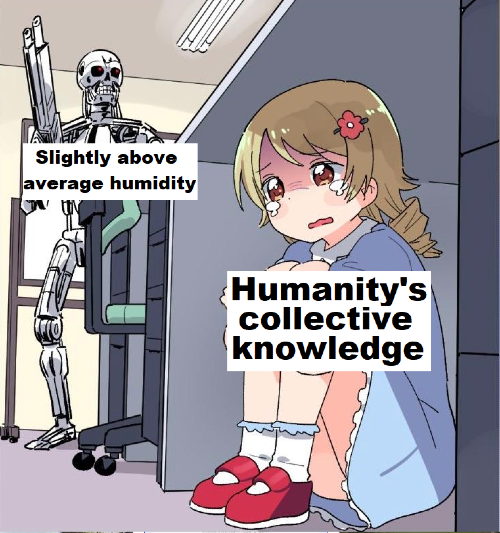
Then we started to store things digitally, which we foolishly believed was permanent, but actually, thanks to various mechanisms of data decay, if you’re not continually resuscitating and backing it up, your files are just going to kind of die of old age eventually no matter what you do.
Since the founding of 4chan, the evil ancestor of what we now call social media and the source of many of our problems today, the forum came with a novel mechanic—after a certain amount of time, if people stop replying to a thread, the thread is erased. That is how the community wanted it to be. It’s also sort of a microcosm of how much of the rest of the internet works, just on a shorter timescale. You might think of it as one of the many ways that community got their way with the rest of society.
Blogs die. Websites die. The companies that host them go bankrupt, merge, sell, downsize, purge, repeat. Links break. The content behind them is sealed off like a sarcophagus. If you know its location you might be able to excavate it with the Wayback Machine but otherwise that tomb is closed and lives on, maybe partially, in the unreliable memories of those who saw it. On large social media and content platforms like YouTube and Substack, if a user violates some rule or triggers some moderation action, often the platform will erase their entire body of work from existence when it bans them. (Substackers, back up your newsletters and email lists, I cannot stress this enough.)
This is a problem because, as I said, we are increasingly putting our whole lives on here. Our whole world.
According to recent studies, around 38% of the internet prior to 2013 is gone. That’s more than a third. If I clicked my fingers and Thanos-snapped a third of the written material published before, say, 1900, out of existence, then what would our knowledge of our own story look like?
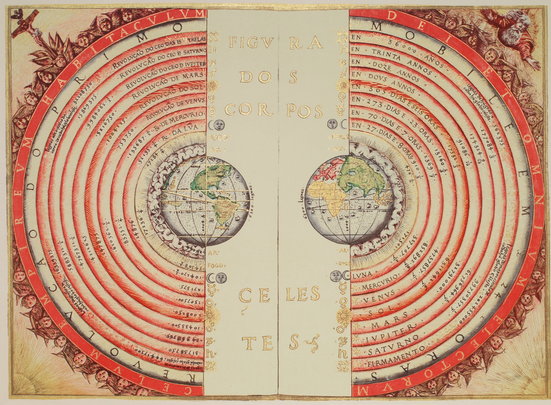
This is one of the many problems we have today that isn’t limited by a lack of technology. If we cared enough about the preservation of our own history then we could store the entire internet, probably, in just one of those data centers that they’ve built to maintain the all-powerful lie machine that steals your writing and takes women’s clothes off.
And when I say “we,” I mean as a collective that includes the men who run that machine—the men who also appreciated the way that 4chan worked and would like it to apply to the rest of our lives.
This isn’t the only way that these men have attacked our ability to access our own life story. Most of the free internet was systematically taken apart and destroyed by the oligarchs in the early 2010s. Before then most of the news was free. We owned our collective story and we discussed it on many hundreds of forums and blogs scattered across the web. The oligarchs arrived inside a Trojan horse. In the beginning, Google and Facebook really were a gift to the internet. They were so useful that we gave them control of the gates to our entire kingdom.
Then the bastards closed the gates and charged a toll.

The actions of these two behemoth websites, which drove a huge percentage of traffic across the entire web, bears most of the responsibility for all of the news websites going behind paywalls. All those forums and blogs that couldn’t afford to pay the ransom withered and died on the vine. All of the stories they contained—our stories—started vanishing behind a white screen and the number 404. Online research became a difficult and expensive nightmare.
I don’t think that these companies anticipated AI when they made these moves. OpenAI hadn’t yet even been founded, and Meta was busy putting all of its eggs—80 billion of them—into the basket of the “Metaverse” virtual reality world. (That basket made a hell of a mess when they dropped it, but they’re still not short of eggs.) Still, they have found more ways to take advantage of the problems that they created for us.
Google is shutting the gates to primary sources entirely as it expands its AI to replace that other thing it does—you know, Google Search. That’s still their most used product, but it also bleeds money because it’s free. Google doesn’t make more money than God by showing you a list of websites that might answer your question. They make money by showing you a list of websites that paid Google to show up in your search results.
But why have search results at all? Most people didn’t like doing research even before the oligarchs made it difficult and expensive. People don’t want a list of links, they just want to ask a question and have Google answer it. Ideally, they get rid of links to websites altogether. In the future they’re aiming for, when you type something into Google, you won’t get a list of things to click on, you will just get an LLM’s best guess at an answer, cobbled together from text it scraped from the internet, plus some links to products and services that paid to be there.
The death of the internet will accelerate when the AIs tighten their anaconda grip on individual websites. And you might rightly ask, if AI kills websites, where will it get its information from?
The answer is, of course: The highest bidder.
This book that I'm writing will help to bridge the gap in our history that the dying internet has left, and explain how online culture drove a sharp, rightward turn in the west. The working title is How Geeks Ate the World and if you like this newsletter then you'll probably like my book. If you're unsure, the good news is I’m going to be dropping parts of the draft into this very newsletter as the project comes along—but only for paid subscribers. So if you want to read along in real time, please consider subscribing. Otherwise I’ll be keeping you in the loop. Check it out here: