Why Normal People Idolize Movie Villains
I can’t help but think, whenever Pete Hegseth speaks, that he is imitating somebody he saw in a movie.
Of course, this isn’t surprising. This is the Ratings Administration, staffed full of television personalities and social media influencers, whose whole thing is using modern persuasion methods to get people hooked into the same old scams.
There is nothing so predictable as the Republican Party becoming the party of war again. After spending the 2010s selling themselves as peaceniks who roundly rejected the Iraq war as a mistake based on a lie, as soon as the TV President came on the scene and brought on his TV Secretary of Defense—Fox News host, Manosphere influencer in another life, “Hollywood” Pete Hegseth—he immediately retitled himself (colloquially, with no authority to do so) the “Secretary of War,” reclassified drugs as a “weapon of mass destruction” and thus drug dealers and traffickers “terrorists.”
(A terrorist, by definition, is someone who threatens or commits violence in order to instill fear in a population for an ideological reason. Difficult to crowbar Cheech and Chong into that, but you know, words don’t actually mean anything anymore.)
Now (stop me if you’ve heard this one) Iran and Venezuela are part of an “Axis of Evil” who are harboring “weapons of mass destruction” and need to be invaded and conquered to force a more America-friendly regime change. Naturally, the indignant born-again opponents of the Iraq War are one thousand percent on board with this.
Hegseth is a big, bombastic, superstar with a perfect jawline and hair gelled with Krazy Glue, who steals the spotlight more than anyone in his role probably ever has. How many Secretaries of Defense can you even name, between him and Rumsfeld? (There have been seven).
But all of his off the cuff diatribes come off as so practiced and scripted. He sounds like he’s acting, and not just that, but impersonating.
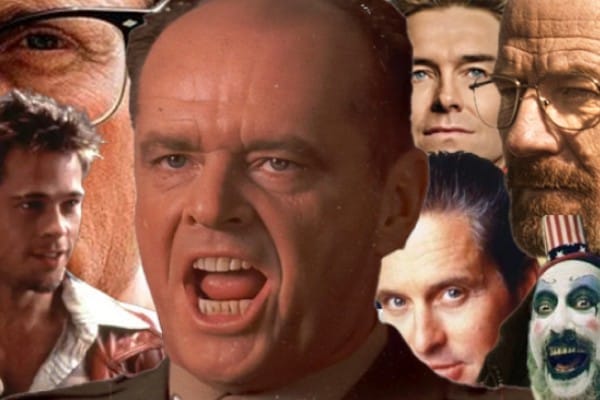
With all his talk about the military being an organization of men who sometimes need to do things that might churn the stomachs of civilians in air-conditioned offices, an organization that needs to be free of “woke” rules against officers beating the snot out of recruits, he sounds like a composite reel of Jack Nicholson’s Colonel Jessep from A Few Good Men. Given that Hegseth is currently under scrutiny for ordering the summary execution of shipwrecked and stranded “drug dealers,” it’s very easy to imagine him ordering a lethal “Code Red” on a troublesome Marine.
Hegseth obviously doesn’t think of himself as a bad person, so why would he style himself after a classic movie villain?
A simple answer is that Pete Hegseth is an illiterate idiot.
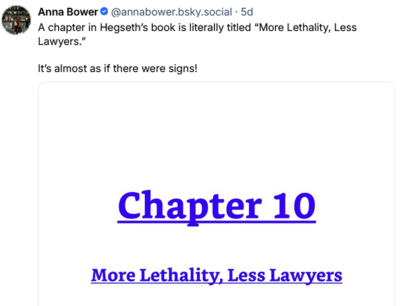
And that’s true, but it’s also more than that. The Trump administration is doing this all the time, venerating characters you absolutely aren’t supposed to look up to.
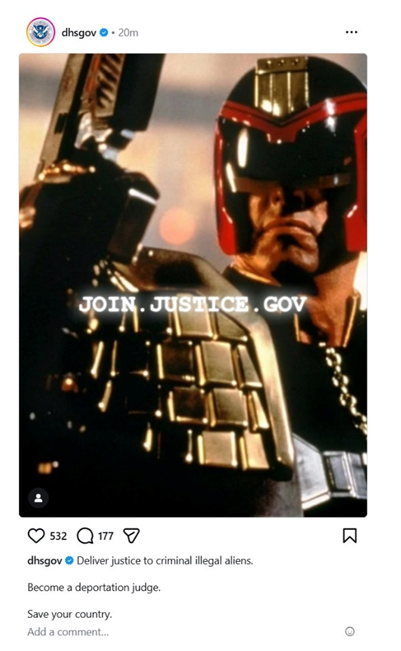
I have a theory of a kind of paradox: that the better the writer, the harder it is to prevent an audience—even a smart audience—from coming away from a movie, show, or book with the impression that the villain was right. Many people will simply reject the notion that these characters are bad influences, and believe their defeat, if they are defeated, is a tragic ending.
A favorite film of mine is 1993’s Falling Down, which follows a divorced, laid-off defense contractor over the course of one very bad day. It’s a rare example of a story in which the villain is also the protagonist. This is a difficult way to structure a story—it’s just kind of the way our brains work that we empathize with the characters that we spend the most time with. Fighting the urge to root for Foster, played by Michael Douglas, as he orchestrates a one-man crime spree during an LA heatwave, is kind of a workout for your ethical muscle.
A lot of people hate this movie and a lot of people love it. You are of course free to hate or love a movie for any reason, but there’s one particular reason people either love or hate it which is based on a misconception: They think Foster is portrayed as the good guy.
He’s not. He’s the protagonist, but he’s a loser whose problems all trace back to shitty decisions he made by his own free will. He’s a stalker, whose ex-wife justifiably divorced with a restraining order due to his short and violent temper. He’s a racist conservative who hates young people and poor people and taxes and inflation and bureaucracy and modernity and minor inconveniences. Foster would definitely have been a Trump supporter.
Here's what paid subscribers are reading right now:
Yet there’s a really cool, even funny, scene at the end of the first act where he terrorizes a fast food restaurant because they’d stopped serving breakfast five minutes ago. You want to give him a high five as he wipes the idiot grin off the patronizing young store manager, but the comedy of this scene is juxtaposed with the terrified innocent families.
This isn’t a movie about a working-class man who’s finally had enough of a system rigged against him. This isn’t Denzel Washington in John Q (which has interesting parallels with Falling Down including a secondary main character, a cop, played in both cases by Robert Duvall). Falling Down is a character parody. Foster is a mean, thin-skinned, upper-middle-class white boomer asshole who is driven to ultraviolence by Kids These Days, by potholes and traffic jams and lazy tradesmen and the fact that fast food burgers don’t look as good as they do in the photo.
There’s one telling scene in which he meets a neo-Nazi and is astonished speechless at the fact that the Nazi aligns himself with Foster. He doesn’t think of himself as a Nazi. Just a patriot.
But a lot of angry boomer assholes did see themselves in Foster. At least as many who thought this was a tone-deaf movie to release in the aftermath of the Rodney King riots.
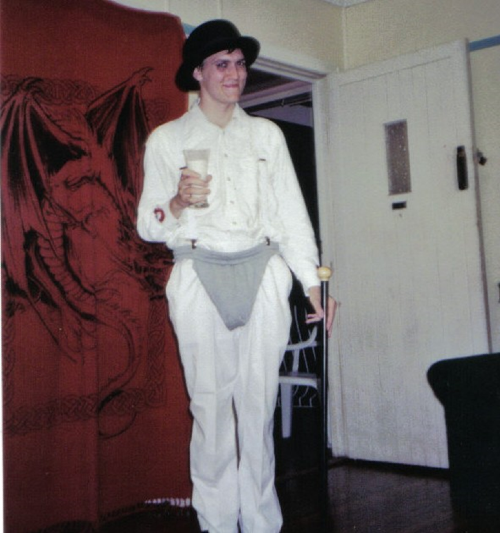
Even a movie intended as a scorching critique of its primary subject will inadvertently make that character a hero to a lot of people simply because the character is their own hero and you’re locked in with their ego. It helps if they’re stylish and cool. There was a little bit of that, I think, in Kubrick’s A Clockwork Orange, whose protagonist I once dressed up as for Halloween.
One movie that isn’t very good but it still did my head in when I saw it is The Devil’s Rejects, a pulpy low-budget Texas Chainsaw knockoff by Rob Zombie. It plays very much like a Thelma and Louise style road crime movie except that the protagonists are deeply evil cannibal rapist serial killers.
Yet everything about the story beats and the cinematography is designed to make you root for them. Everything from the way the score becomes mournful and the action turns to slow motion when one of the murderous family members is killed by police. The sheriff, the primary antagonist, is framed in every way as the despicable Sheriff of Nottingham type villain who is bigoted against cannibal rapists the way Christoph Waltz’s character in Inglourious Basterds is bigoted against Jews, and about as sympathetically.
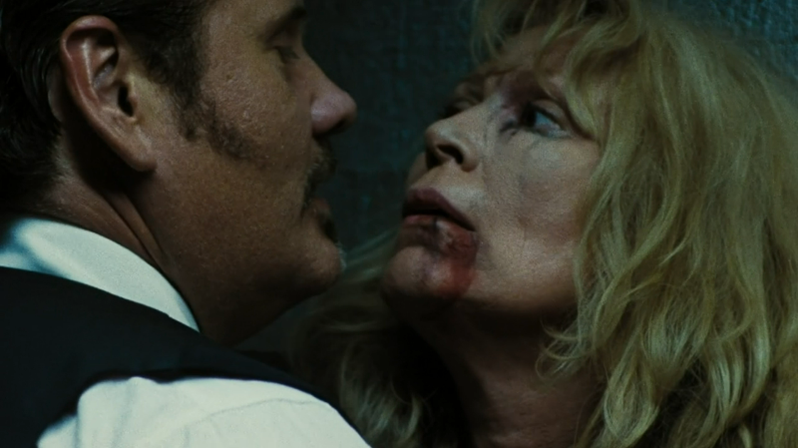
In the end the sheriff catches up with the Final Girl—who had just mutilated and serial-killed her way through Texas—and tackles her while she screams and cries…
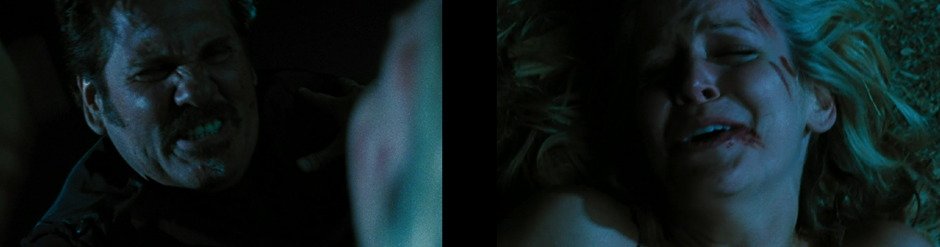
…only, with a celebratory and victorious score change, to be valiantly rescued by the movie’s Leatherface analogue.
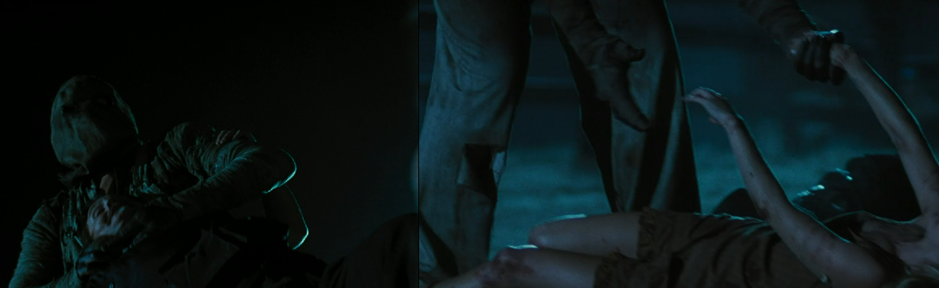
It’s an incredibly jarring movie and I don’t know whether Rob Zombie was trying to make a point of whether he just wanted to make a fun slasher movie. In either case, he does seem fully cognizant of a fact that many fans and even possibly filmmakers of slashers don’t quite get—that these movies kind of wind up having the audience root for the killer.
You know why? Because the killer, especially in franchise slashers, is usually the most fleshed out character. Freddy and Jason and Michael Myers and Chucky and even Pinhead have deep, complex, human backstories and motivations (with the exception of Michael who, famously, has no understandable motivation and the writers have been commendably consistent with that.) Their victims, usually, have little to no lore.
It's one thing for slasher movies to hack our brains into kind of liking serial killers, at least for the runtime of 90 minutes, but I don’t think there are people, or hardly any, who wind up idolizing them and it would be kind of moral panicky of me to suggest that they do. It’s when you combine cinematic framing with a well-written character whose ideology a segment of the population is prone to agree with—especially if they are stylish and charismatic—that you get people idolizing that character even if the movie is explicitly trying to explain why you shouldn’t.
A classic example is 1987’s Wall Street, whose villain Gordon Gekko—again played by Michael Douglas, coincidentally—was a huge inspiration for young men to enter finance and go work for Morgan Stanley.
Gekko, also, would have been a Trump supporter. Scratch that, he would have been Trump. I have no evidence that writer-director Oliver Stone was inspired by Trump, but Wall Street’s release coincided with the publication of The Art of the Deal, and Gekko made the kinds of speeches that Trump would make if he were capable of stringing his thoughts into grammatically correct or even coherent sentences.
Stone’s adroitness as a filmmaker was to show how capitalism raises criminals and hucksters to the highest corridors of power through their charisma, and the way they give permission for people to believe what they already want to believe—in this case that “greed, for lack of a better word, is good.” But this is kind of like explaining to people how the Palantir works to corrupt minds by… showing them the Palantir.
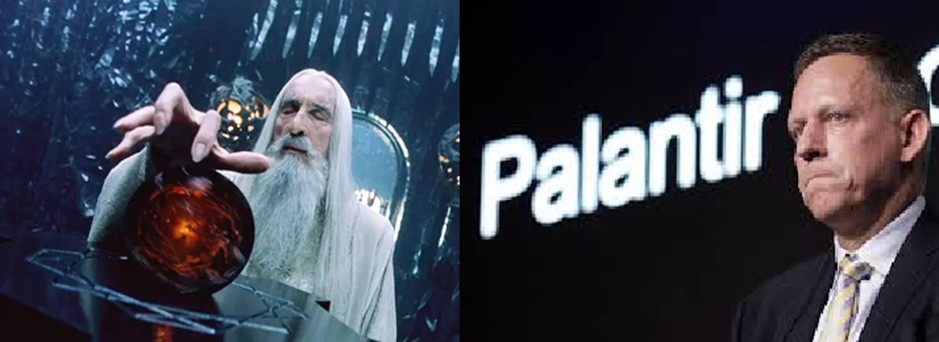
I’m not necessarily criticizing Oliver Stone. It is a true conundrum. It is difficult to warn about how people’s minds can be tricked into bad ideas, or even cults of personality, without demonstrating it. Gordon Gekko, like Trump, was not a talented businessman. He was a corrupt, cheating fraud. But even though he got caught in the end, this still managed to convince a generation of young bankers that a smart way of getting ahead is to be a corrupt, cheating fraud.
(I can’t find a way to seamlessly work in the deleted scene from Wall Street 2 where Trump actually makes a cameo with his shitty acting and they cringingly and bafflingly make Gekko into a Trump sycophant, but I also can’t leave it out, so here. I totally see why this was cut.)
It's kind of difficult, in fact, to make a Trump-like character to satirize him, without a large chunk of the population responding “yes, this is why we like him.” For example, TV series The Boys, which falls into the now-cliché genre of “what if Superman, but evil?” The primary villain, the evil-Superman named Homelander, couldn’t possibly be a more explicit parody of Trump unless someone jumped out of a crowd and spraypainted his face orange while he screamed “Agh, covfefe!!”
Still, it wasn’t until the third season, after Homelander falls in love with an actual Nazi named Stormfront and starts threatening to commit genocide, that Trump supporters began to believe that this was an unflattering portrayal of a character they really quite liked.
I think the most prominent example of people “missing the villain” in recent film history has to be Fight Club. I love Fight Club but it’s something I have to kind of keep to myself because loving Fight Club is about the biggest red flag a white guy can throw up.
Brad Pitt’s Tyler Durden is a downright manosphere superhero, to the point that a prominent pickup artist uses that as his pseudonym, as does the author of the far-right blog Zero Hedge. Durden, in Fight Club, is the Platonic masculine physical ideal. Of course he is—he’s Brad Pitt. But he’s also smart in the way that a first-year intro-to-philosophy student, who is a decade older than the other students and has done a lot of internet research on Nietzsche beforehand, is smart.
Tyler Durden probably would have been a Trump supporter. Like Trump, he is a stupid person’s idea of a smart person. Also like Trump, his philosophy of individualism, fighting the system, and conquering the elites, collapses inevitably into a regimented personality cult of sycophants who think the same, act the same, dress the same, and commit aimless, DOGE-like violence against random targets of the system they believe is keeping them down, blaming everybody else for their own failure.
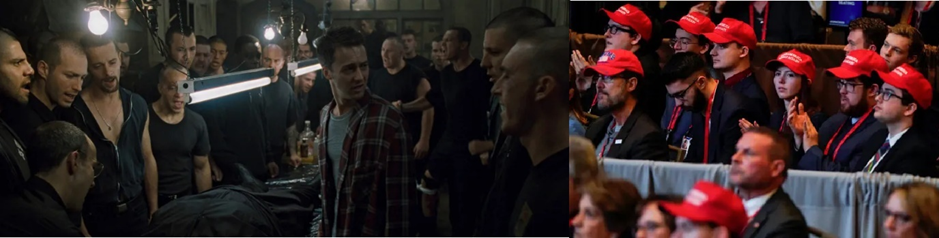
People who take the wrong message from Fight Club can’t see past the performance or the ultimate message of the story. If you’re one of the five people on Earth who doesn’t know the twist ending I’m still reluctant to spoil it and urge you to see it, but suffice it to say it undoes any “Tyler was right” reading of the story and I’ve seen multiple insufficient attempts to reconcile it.
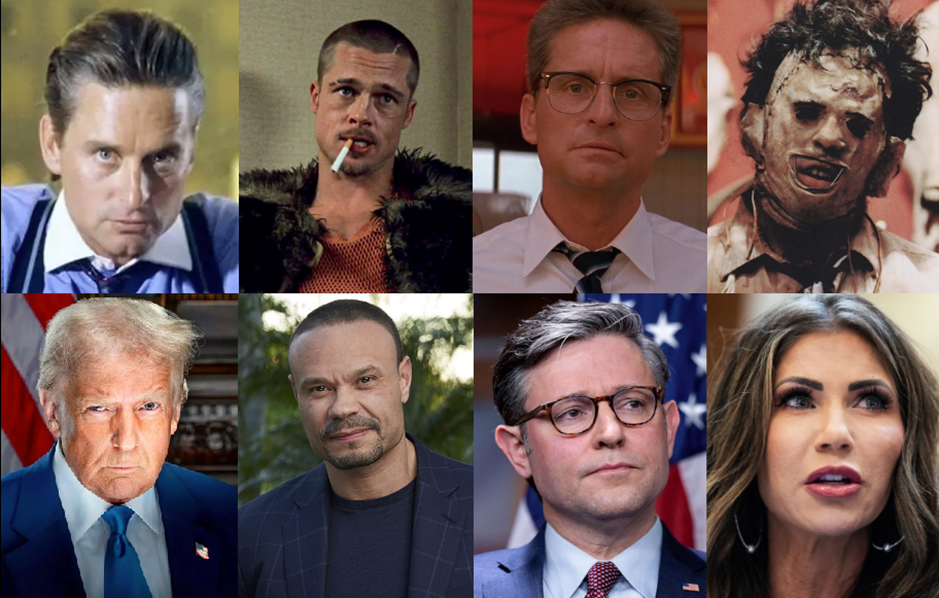
There’s no way to guard against people taking the wrong lessons from narrative art, it’s a problem that will stick with us as long as people with shallow literacy are exposed to it, which is forever. The course of action is to avoid putting those people into power positions. Don’t make Gordon Gekko the President if you don’t want Colonel Jessep to be the Secretary of Defense, Tyler Durden to run the FBI, Bill Foster to be the Speaker of the House, or Leatherface to head up Homeland Security.
I'm writing a book that goes into more depth about how the rise of the internet propelled far-right toxic masculinity to the American Presidency in the space of a single generation. The working title is How Geeks Ate the World and I’m going to be dropping parts of the draft into this very newsletter as the project comes along—but only for paid subscribers. A new chapter is coming out this very weekend! So if you want to read along in real time, please consider subscribing. Otherwise I’ll be keeping you in the loop. Check it out here:

Here's what paid subscribers are reading right now: