Why You Can't Treat Online Communities Like Offline Communities

I don't like talking about Substack much because a lot of my Ghost audience subscribes specifically to get away from Substack, and I hear you. But part of my beat is talking about online communities and, for this week's topic, Substack just happens to be my case in point. It's not a unique phenomenon to that platform.
On June 3rd a Substack writer named Robert M. Hamburger—who had, at the time, a few hundred subscribers, and whose pieces average somewhere between ten and thirty likes—published a piece that was liked over five thousand times with over two thousand reshares. A spectacular hit that went more viral than probably anything I’ve ever seen on the platform.

It’s titled “An Open Letter to Chris Best, CEO of Substack.” Its immense irony is a brutalist work of art.
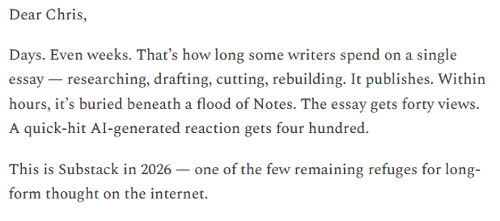
First of all, it’s very obviously AI generated. The very first line is the exact type of wistfully condescending hack prose that ChatGPT or Claude always spits out when you ask it to compile some kind of manifesto: “Days. Even weeks. That’s how long some writers spend on a single essay — researching, drafting, cutting, rebuilding.”
It’s a style—if one regards the algorithmic average of all amateur writing, both underwritten and overwritten, smoothed into a homogeneously sterile medium-written block of words to be a style—that flows through the entire essay. The first irony smacks you when you read a little further and discover that this thing is a tirade against AI.
If you read the whole thing—it’s short and thinly written, which helps with virality—the ironies compound. It’s not just a tirade against AI. It’s a complaint partly that short and thinly-written AI generated content is drowning everything out and going viral at authentic newsletters’ expense, and partly that the addition of a Twitter-style social media feed at Substack’s home page has turned essay writing and discoverability into an exercise at gaming the algorithm much more than quality writing.
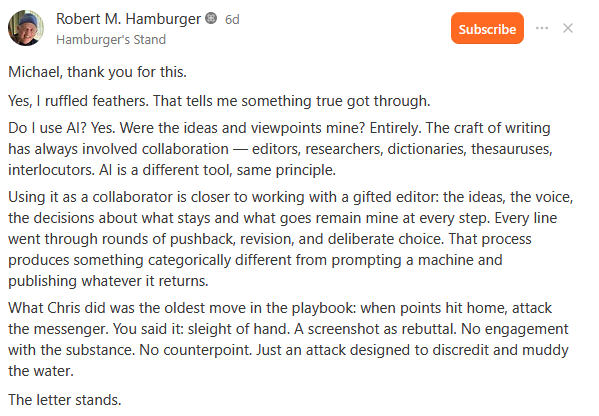
It’s tempting to believe that Robert Hamburger is a genius who deliberately wrote a self-proving thesis. I don’t think that’s true. I suspect he’s being earnest and thinks that his usage of AI doesn’t detract from the broader point that he prompted it to espouse. Amusingly, after Chris Best responded to the piece by simply pointing out it was AI generated, another writer came to his defense by arguing for its authenticity and attacking, at length, the legitimacy and accuracy of AI detection tools. Hamburger responded to this, shooting his own defender down in flames, with an admission that he actually did use AI, in a note that was also obviously generated by AI.
Okay so he can’t write without AI. Sadly, a lot of people can’t anymore, so let’s drop that for now. The important thing is that several thousand people agree with ChatGPT or Claude or maybe Grok’s interpretation of Hamburger’s actual point, here. So, is Hamburger actually right?
The answer is yes, in some ways, but not exactly in the way I think he realized.
I don’t often write about Substack. I’ve published over 150 pieces to that platform now and maybe 10-15 of them have referenced the platform itself and its community. But I’m looking now at the most popular pieces I’ve ever written in order, in terms of views and engagement: Of the top ten pieces, six are entirely or largely about Substack. (The links here point to the Ghost mirrors of these pieces, if you don't want to give the site traffic) That’s the most popular, the second most popular, the fourth, the sixth, the seventh, and the tenth. Special credit to the thirteenth most popular, which is also entirely about Substack.

I don’t count many of these among my best pieces, but it does seem to be the case that, if you write about Substack on Substack, it rips through the algorithm like fire through the Palisades. It doesn’t seem to matter if you’re complaining about Substack as long as you’re talking about it.
The Substack algorithm is a black box, as are most social media algorithms. They’re not going to tell us how this all works. The question is: Is the fact that posts about Substack do really well on Substack due to an algorithmic pressure that pushes Substack-related content? Or does Substack-related content overpower the algorithm because people just share it so enthusiastically?
I think I would be surprised if Substack didn’t algorithmically entice people to talk about the platform itself, but the result, whether forced or organic, is the same: Substack strongly considers itself a community, and people have strong thoughts about their communities.
The social media web is now almost completely balkanized in a way that it wasn’t at the height of what they called Web 2.0. The Muskening of Twitter back in 2022, I think, was a major driver of this. Before traditional social media we used to be confined to our own spaces on the Web, but then everything condensed into a few large platforms, and most people who used social media were active on a bunch of them. Then the Twitterpocalypse happened and the internet shattered again.
Now: Twitter hates Substack and Bluesky; Bluesky hates Twitter and Substack; Substack hates Bluesky and Twitter; the Meta constellation nobody really talks about on any of these three platforms but they’re probably over there doing their own thing and hate all of us.

Though some people try to spread themselves thin across all of these platforms I think most social media inhabitants consider themselves primary residents of one or another. But this is where our own minds betray us, because we’re trying to map our experience of living as human beings in physical communities onto our experience of interacting online with digital communities.
This is where writing or pushing an open letter to Chris Best about some sort of unrest in the community doesn’t really make any sense. He doesn’t care. I don’t mean he doesn’t care because he’s a mean asshole (he might be? I have no idea) but it’s not his job to care. Chris Best isn’t the Mayor of Substack. He isn’t campaigning for reelection. He’s looking at a spreadsheet with dollar signs and graphs on it and the line is either going up or going down.
The “open letter” is packed full of platitudes like “We came for thoughtful writing. For original ideas. For the experience of sitting with another person’s perspective long enough for something meaningful to unfold. The article is the soul of Substack.” But nobody who is running the company has the least bit of interest in what you think “the soul of Substack” is. The soul of Substack is a bunch of numbers. If “thoughtful, deep, original essays” don’t make that line move up as well as quick, churned-out Facebook and TikTok style slop does, then there’s not a lot of incentive to go against what the market wants in order to somehow preserve the “soul of Substack.”
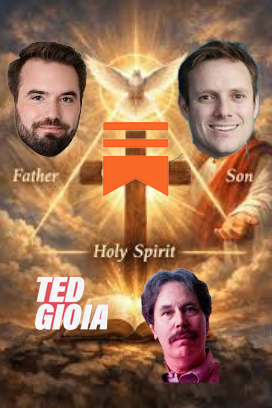
This isn’t something I like, either. When I write about Substack I’m usually complaining. I’m not Ted Gioia. I’ll use the platform but I’m not running free ad copy for techbros. In my aforementioned most viewed article I scooped the fact that Substack changed its algorithms and recommendation models around this time last year in a way that, deliberately, drastically reduced the amount of discoverability that smaller writers enjoy on the platform, to the benefit of bigger writers.
This is very similar to what Robert Hamburger’s chatbot is complaining about. I don’t think he read my piece (as viral as it was, it didn’t go nearly as viral as his did—maybe it would have, if I’d put the scoop in the lede, but I’m an essayist and not a journalist, so lesson learned). The difference between he and I is that he seems to think this is a situation that Substack wants to fix rather than one that they deliberately engineered. Again, if you want to read my piece I’ll tell you exactly why they did this.

That article wasn’t a letter to Substack. It was a letter to the community to report on the fact that Substack fucked them and didn’t tell them. They’ll keep doing that, because their job is not to foster a community, it is to sell a product, and they will adjust the product to serve the market, not the community. In cases like 2023’s “Nazi Problem” uproar, they will speak to the community to do damage control, but other than that, they’re just there to hype the product. In online communities, the community leaders are not the staff of the company, they are the power users of the platform.
This isn’t just a Substack thing, of course. Most of these platforms tend to see themselves and each other “a certain way” and develop a sense of community even if not a shared ideology. It’s difficult to develop individual users as community leaders when the viewpoints are fairly diverse and the algorithm is so complex and difficult to understand.
Bluesky is closer to a political homogeny and they, too, have a tendency to appeal directly to the staff of the platform as community leaders who should be responsible for enforcing cultural stability on that platform. The problem with Bluesky, at least in the past, is that the staff of the platform have responded in kind, to disastrous results, because doing so worsened an adversarial relationship that was developing between the platform owners and the power users who had, in fact, become the actual community leaders.

Twitter (“X,” if I fucking must) is sort of an outlier here because Elon Musk really is the primary community leader of that platform, which is why it is practically Stormfront now. Musk taking the reins and using his legitimate power to force a particular culture did not work out great for the culture that organically existed before him.
Given these two examples, it should be apparent why nobody should actually want Substack’s owners to act like its community leaders. It would be deeply inauthentic (they will never act against their interests if they conflict with the interests of the community, as they often will) and would, in all likelihood, drive the culture in a specific way that would make a lot of people very angry.
Oddly enough, it is actually Robert Hamburger(‘s chatbot) who is acting more like a community leader in this situation—as evidenced by the massively viral circulation of his “open letter.” Aside from the misguided attempt to appeal directly to the Chief Executive to make product adjustments, Hamburger is giving voice to concerns of the community and his post acted as a nucleation site for discussion, spleen-venting, and general, you know, feeling of community.
I don’t want to compare Robert M. Hamburger to Martin Luther, but there’s a reason Luther addressed the 95 Theses he nailed to the church door to the public, and not just the Pope.
That is what people concerned about “the soul of” their online communities should be doing—keeping their fingers on the pulse of the community and providing an outlet for people to talk about what’s on their minds. Act as watchdogs against the platform owners when they act against the community’s interests, but don’t act like some sort of revolution is possible. Again, online communities are not like offline communities, unless maybe you’re all shareholders.
So hey, I'm writing a book about toxic masculinity, online culture, and how it all led to Trump. The working title is How Geeks Ate the World and if you like this newsletter then you'll probably like my book. If you're unsure, the good news is I’m going to be dropping parts of the draft into this very newsletter as the project comes along—but only for paid subscribers. So if you want to read along in real time, please consider subscribing. Otherwise I’ll be keeping you in the loop. Check it out here: