Graham Platner and the Trolley Problem
I hadn’t intended to talk about Graham Platner. I’ll talk about the right and the left using American politics as the reference, but I try to steer away from granularity that I can’t purport to understand. In short, all I really know about Maine is that’s where Pennywise lives.
However I also write about masculinity and toxicity and online discourse, and there’s plenty of all of that in this story, so here goes.
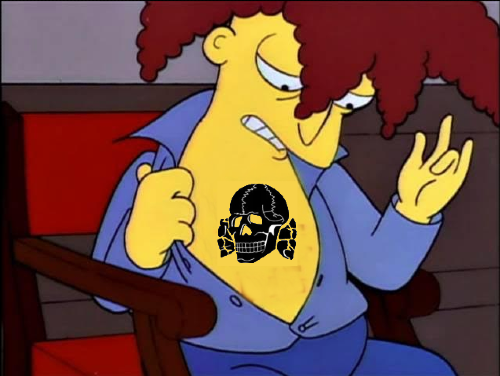
Graham Platner is, at the very least, a massive jackass. To say nothing yet about the people he’s harmed in his life, even running for office with his kind of baggage is incredibly reckless. Opposition research found a Facebook message that JD Vance deleted in 2016, you think they’re not going to find out that you once locked a woman in her room to end an argument? Or that you have an SS Totenkopf prominently tattooed on your chest?
So now he’s massively screwed up the Senate midterms for Maine Democrats by managing to… well, I have to be careful, here… allegedly hide a sexual assault or rape long enough to win the primary but not long enough to get elected and serve out his term. And of course I believe in innocent until proven guilty but I also don’t find anything implausible about this story.
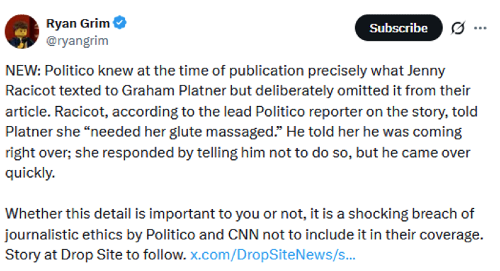
The contrarian takes that have emerged to defend Platner and call his accuser a liar don’t make a convincing case, and for most of them the best way they could help him out here is to stay silent. Reporter Ryan Grim thinks his accuser led him on, and that this fact is being omitted by the mainstream media.
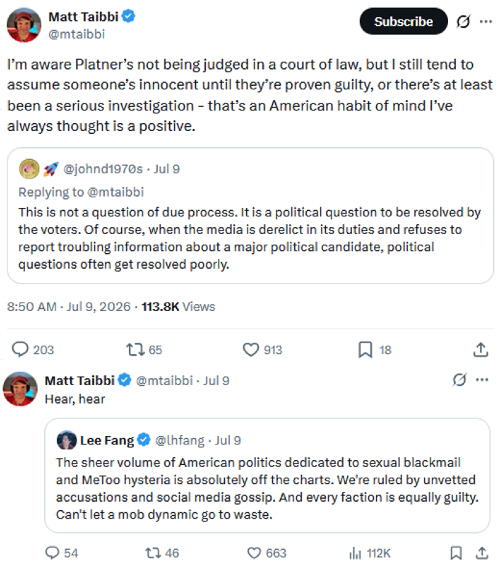
Then there is, of course, Matt Taibbi and Michael Tracey, who have teamed up recently to enter into some kind of Men’s Right’s Activism phase. Taibbi, who has been outspoken about the supposed epidemic of false rape accusations against prominent men ever since he felt the wrath, perhaps unfairly, of the MeToo movement himself, thinks that such accusations just shouldn’t be reported on at all, at least not until some sort of full criminal investigation has run its course. His fellow quasi-MRA Twitter-Files journo Lee Fang concurs.
Michael Tracey views high profile sexual abuse accusations like his own personal bat signal for some reason, swooping deftly into the discourse slinging his lying-whores batarang. He’s recently been in the public eye as a contrarian about Jeffrey Epstein, and while I’ve been vocal myself in doubting that Epstein raped half the world as some people contend, Tracey’s thing is that Epstein never even cut the tag off his mattress let alone committed a sex crime.
His own spittle-flecked rant about what he sees as a particularly flagrant false accusation in Platner’s case delves into deep conspiratorial territory that at one point seems to suggest that Platner’s accuser was sort of hypnotized by malicious actors into constructing false memories of a rape that never occurred.

There are numerous reasons why various people want to push so hard for this false-accusation narrative, and particularly for those who didn’t like Platner and maybe don’t even like Democrats to come out swinging for him now, a lot of it does come down to misogyny and the bro code. For those who actually did support Platner and weathered his scandals, and who are not ideologically misaligned with feminism, that doesn’t necessarily tell the whole story. It’s also cope.
As every piece I’ve read by people still on the Platner bandwagon has argued that the events of which he is being accused never took place, I’d like just one of them to answer: What if they did?

Here's what paid subscribers are reading right now:

There is nothing inherently contradictory about somebody sharing political positions with you who has also committed some kind of sexual abuse. It is an error, one born of coping strategy, to put all rapists on the political right. This is a misconception that needs to be corrected. However, to this point, a lot of progressive people—men and women both, and ardent feminists—have been trying to cope for a long time, and I don’t think they should be condemned for that. They have been put in an increasingly difficult position.
Of all the various social medias, it probably comes as no surprise that Bluesky was trying the hardest, for the longest time, to get Graham Platner off the Maine ballot. Since the latest accusation, the “apology form to Bluesky” has been something of a meme on Twitter. Ever since the revelation of his tattoo, and possibly before that, Bluesky-ers have been feverishly urging voters not to go with this guy. Power to them—they were right to.
But there were people who also saw the ominously encroaching truth: Bluesky does not have the cultural capital that its users often feel they do. Voters in the Maine primaries aren’t on Bluesky. Let’s face it, most of them aren’t on Twitter either. For those of us who do use these platforms it is easy to forget that they are both relatively small, and that most people out there in the world, to the extent that they use social media at all, are confined to Facebook and Instagram.

The fact that became impossible to ignore for some was that whatever strategies the Platner campaign was using to weather his scandals were working on the public and that he was going to win the primary, and it wasn’t even going to be close.
The question was, what then?
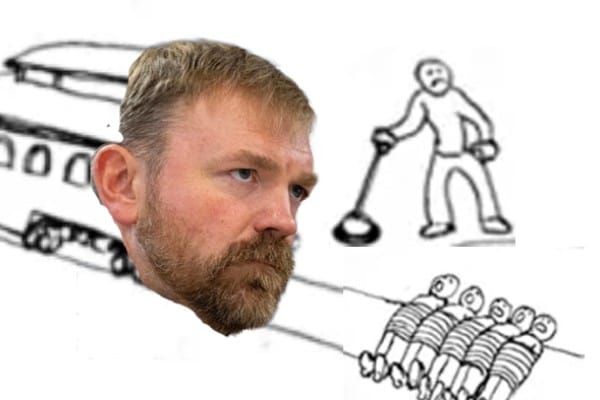
Democratic voters who weren’t fine with Platner found themselves trapped in a trolley problem. If you’ve never heard of a trolley problem—I mean you probably have since you’re on the internet, but if you haven’t—it’s an ethics thought experiment in which an out-of-control trolley (a train) is speeding down the tracks and it’s going to hit five people. You have a choice to switch it to another track, but there’s a person on that track as well. This is the only action you are permitted. You don’t get the option of nobody getting killed. The only power you have is over who gets killed, and how many. The dilemma is between the harm reduction of action versus the clean hands of inaction.
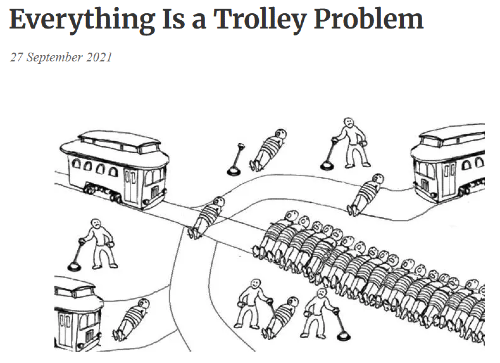
Platner was going to win the primary. Moreover, he was likely the only candidate who stood a reasonable chance of beating Republican incumbent Susan Collins. Moreover still, beating Collins is important—not crucial, but the least difficult way—for Democrats to take control of the Senate this year, and thus remove a significant amount of power from Donald Trump.
This is the question that people, particularly those in Maine with actual voting power, who couldn’t avoid these facts needed to ask themselves, with increasing moral tension within themselves. After Platner’s tattoo came to light; after his questionable past social media posts; after his history working as a mercenary became laid out; after his history with women: At what point is a Democratic Senate with Platner in it no longer preferable to Donald Trump retaining full control over all levers of the government for another two years?
It’s true that this is a false dilemma—it is neither inconceivable for someone else to beat Collins, nor is beating Collins essential for taking the Senate—but it is a true fear, and in fact, it is this exact fear that held Platner’s accuser’s tongue. According to Jenny Racicot, “One of the reasons I didn’t come forward sooner was, the huge moral conflict that I had between supporting his politics, but not supporting him as a person.”
To be clear, I don’t think there is much of a moral argument to be made for Platner in the Senate in the full light of these latest allegations, but it is counterproductive for anyone to pretend that this internal conflict did not exist, was invalid, or was shameful. It is, in fact, an insult to Racicot, the very woman we are supposed to be sticking up for here.
Yet this shaming did occur. People were dogpiled for merely asking people to confront the fact that they were going to face some difficult internal conflicts when—not if—Platner won the primary. Independent journalist Jonathan M. Katz was particularly put through the ringer for this crime. People insisted that there was a chance for Platner’s closest opponent—whose support was practically a rounding error—to rocket ahead in the primary if Bluesky pushed hard enough. Either that or some write-in candidate. Doubting this was seen as akin to supporting Platner, loving Platner, wanting Platner to be President of Earth.
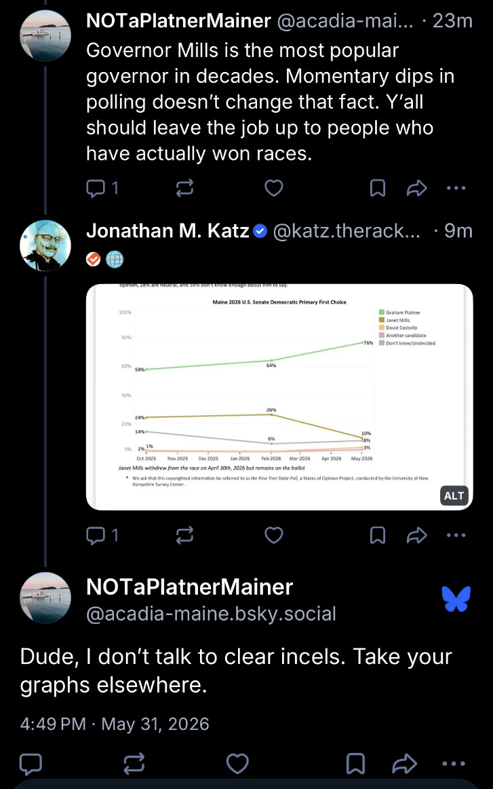
Now that the worst (god willing the worst) has surfaced, the rage has rekindled, and the very people who warned that they needed to prepare for Platner winning the primary are now targeted as being responsible for Platner winning the primary. Again, through some kind of misguided impression of Bluesky’s influence over the Maine electorate.
In an immense irony, Katz—a Jewish journalist you might recognize as the consistently anti-Nazi writer who drove the Substack has a Nazi problem discourse that made Substack writers persona-non-grata on Bluesky—is now being accused or at least heavily implied on Bluesky to himself be a Nazi or a Nazi sympathizer, due to Platner’s Totenkopf tattoo.
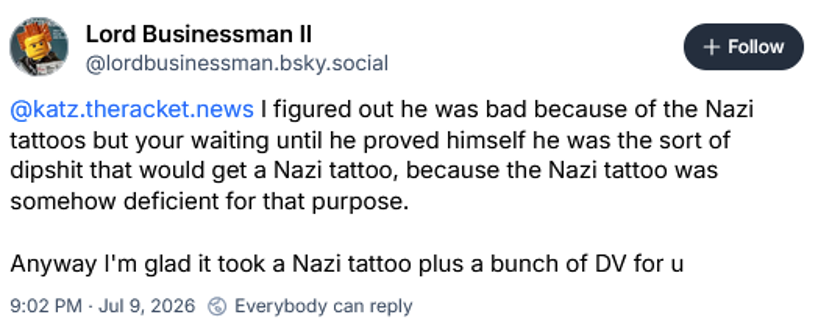
Platner’s excuse for the tattoo was ignorance, but many of his haters, from the beginning and now especially in light of the latest allegations, took it as evidence that he always was and still remains, ideologically and truly, a neo-Nazi. This is, I believe, just another coping strategy—he ran successfully as a progressive, so he would have to be a clandestine undercover Nazi, but even if so, it wouldn’t make much sense for Racicot, who is in a better position than anyone to know he’s a Nazi, to agree with his politics, unless she is also a Nazi... which would make this whole thing a bunch more complicated. But, him being a Nazi resolves any anxiety about preventing him from ousting Collins, and it also resolves the anxiety of a rapist being on the left. It’s cope.
The whole Graham Platner fiasco, start to finish, is a garbage fire, and the fault for that lies squarely on Graham Platner, and I guess the people in the party who discovered and encouraged him and ran him apparently without any kind of scandal vetting. He owns what he has done to the people he has harmed and the damage that he has done to the very political movement he wanted to lead. Anger at him, I believe, is warranted.
You can’t put that anger on good people who saw what was happening to their entire country, who stressed about it every day, who saw a potential solution, who grasped it in their hands, and who struggled in despair as it gradually began to turn to sand between their fingers. You can’t hate people for struggling with when or if to switch the trolley to the other track. The fight isn’t over and I hope to god that the pieces can be picked up and the battle can still be won, but don’t attack people for their internal struggle with hope. Hope is human. So is cope.
So hey, I'm writing a book about toxic masculinity, online culture, and how it all led to Elon Musk and Trump. The working title is How Geeks Ate the World and if you like this newsletter then you'll probably like my book. If you're unsure, the good news is I’m going to be dropping parts of the draft into this very newsletter as the project comes along—but only for paid subscribers. So if you want to read along in real time, please consider subscribing. Otherwise I’ll be keeping you in the loop.

Here's what paid subscribers are reading right now: