How We're All Losing Our Grip on Reality
So Senator Mitch McConnell is alive, for better or worse. The heart attack with his name on it missed and clipped Lindsey Graham’s aorta. At least that’s the official story. The internet remains largely unconvinced—not that Graham is dead, which seems pretty incontrovertible, but rumors of McConnell’s death stubbornly persist.
This despite a selfie that he posted of himself and his wife in the hospital, looking right as rain, and holding up a copy of that day’s newspaper in a subtle nod of acknowledgment that this proof of life was going to require some extra weight.
Folks aren’t buying it. AI can do this now!
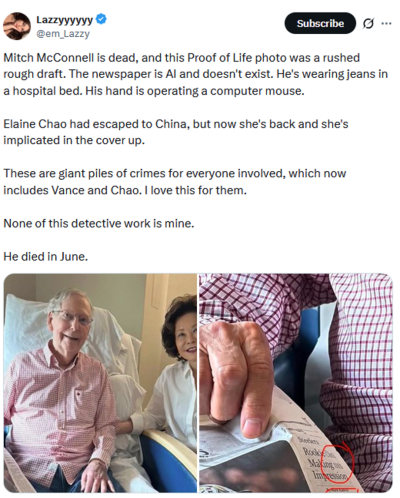
As social media detectives will tell you, this isn’t even good AI. It’s riddled with errors. Jeans in a hospital? And look how weird his hand looks!
While I concede that AI probably can do this now, I am not so cynical as to believe that’s what this is. There are too many other elements to the conspiracy theory for it to be plausible (not the least of which is that they would have to concede that he’s dead eventually) and there are no suspicions about the photo that don’t have a perfectly reasonable explanation. But if you look over social media, the AI photo hoax looks like the dominant narrative. And folks, this is our lives now. This is the new normal.
Plenty of people are having fun with this, and generating obviously fake videos of McConnell getting out of bed and dancing around or throwing his wife out a window or morphing into a turtle or whatever. I stopped finding AI fun in any way quite a while ago. But a lot of people, I don’t want to say most, seem somewhere on the spectrum between ‘suspicion beyond what’s healthy’ and ‘staunch rejection of the evidence.’
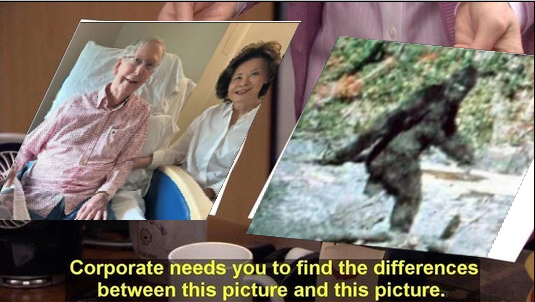
And believe me, I know very well that this isn’t a new phenomenon. Before AI image generation, conspiracy theorists would say that images were photoshopped. Before that, they would say that body doubles were used, or lookalikes, or clones. Motivated reasoning and the desire to manufacture evidence of what you’ve already decided to believe are tendencies as old as humanity, and AI is just another enabler.
But man, I’ve been debunking conspiracy theories for a long time and haven’t seen anything on this scale before. We are, all of us, quickly losing the ability to grasp what’s even real. Normal people have already left the building. Experts remain who can still tell, but the AI companies are breaking them down.
The assault is coming from two sides: Those who object to AI but over-diagnose its presence in everything they see online, and disinformation agents who actually use AI to either bolster their argument or troll the discourse and maliciously poison the entire discussion. For fun, I suppose.
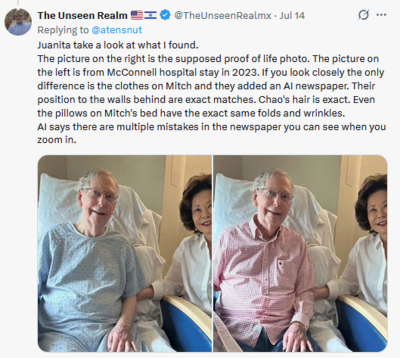
What distinguishes this from your everyday conspiracy theory mindset is that people who are not ordinarily like this have trapped themselves into a situation where they obsess over the various “tells” of an AI-generated image, inspecting every minutia, to the point where actual snapshots of genuine reality now seem strange—the position of a hand; the way fabric falls; a texture that doesn’t seem right.
Conspiracy theory is not, in itself, the product of some mental illness. It is very much part of our humanity. We all want to be unique. We all want to be the one who figures stuff out. The first person to come up with a theory about how 9/11 was staged wanted to tell the world what he thought he’d discovered. He wanted to be the one who cracked it. AI hoax detectives are no different in their motivation. When everyone else is falling for the bait, you want to show them the abnormalities—the weird fingers, the weird expressions, the things the machine didn’t quite get right but you spotted it.
The ubiquity of AI is tapping into this urge deep inside all of us and touching it in more of us than ever before. When we suspect foul play, we will search for evidence, and when we search, we will usually find it, even if we have to massage reality for it to become clear to us.
Here's what paid subscribers are reading right now:
One night in early July, the former professional footballer and current California State Assembly candidate Chris Kluwe crashed out on Bluesky after someone shared a photo of Melbourne street art that Kluwe accused of being AI-generated.
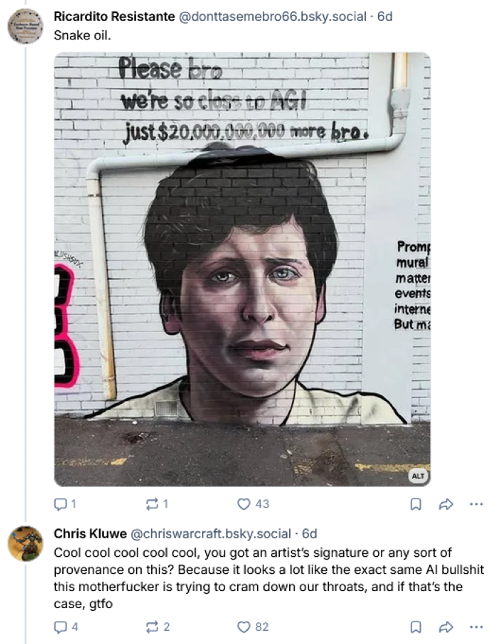
The art is real. It’s by a famous Australian anonymous street artist called Lushsux, considered by some to be Australia’s Banksy. But posting the artist’s Instagram, which includes more photos of the piece from different angles, was not enough—you see, plastic dumpsters aren’t shiny like that.
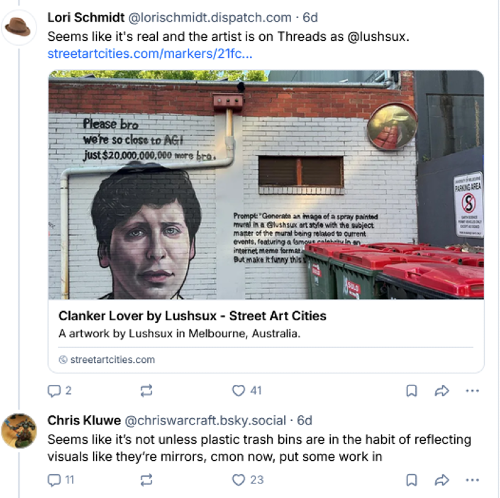
Again, the contention that, not only is this AI, but it’s sloppy AI. It’s not even hard. The thread became an exercise in futility for dozens of people who put in the earnest work of actually researching and proving the artwork’s existence. Every reply just entrenched Kluwe deeper in certainty that this was not a real image, and maybe Lushsux’s entire career is fabricated by AI.
People dug up articles about it, they found video. None of it matters—the wall looks too clean, the dumpsters aren’t damaged enough, and there’s a mirror that doesn’t look functional for its purpose. Fake, fake, fake.
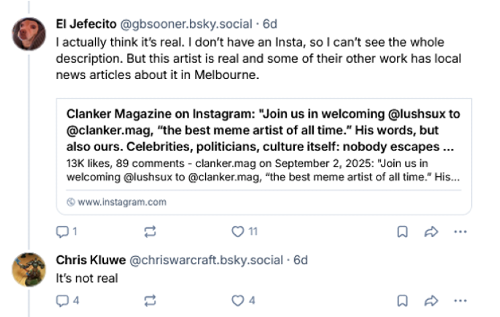
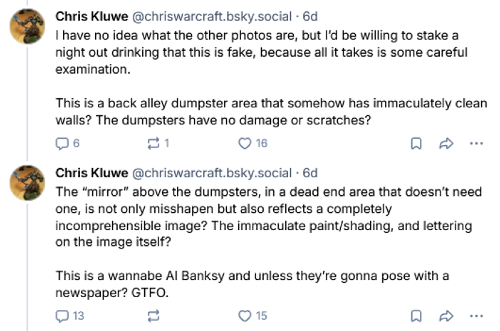
Eventually, someone found the alley on Google Maps Ultimately, they found the artwork itself on Google Maps.
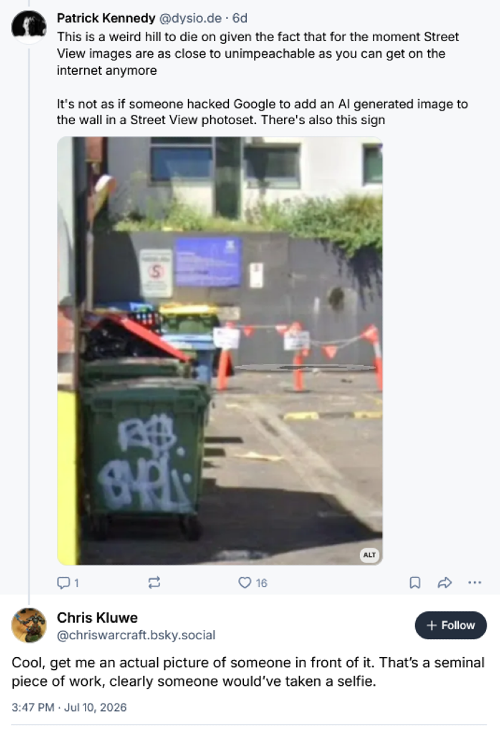
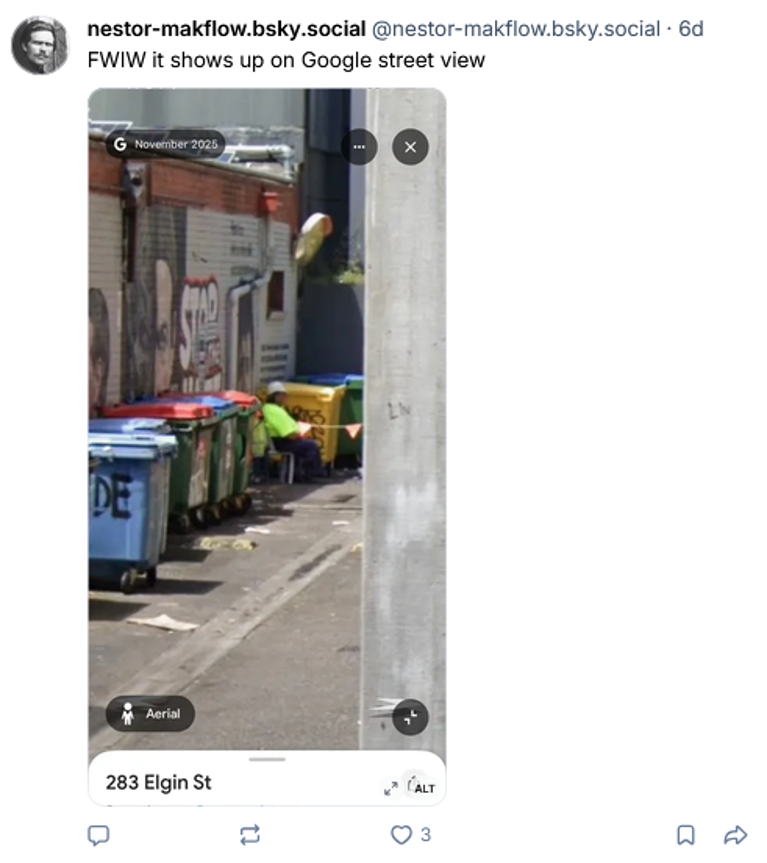
It didn’t budge Chris Kluwe one inch. It is easier to believe that somebody went so far to push this hoax that they were somehow able to doctor images on Google’s own servers than it is to believe in the existence of a weird mirror in an alley.
This is moon landing conspiracy level stuff. Much of it is surely ego, to commit so strongly to an increasingly fragile rebuttal of Occam’s razor, but I believe we’re witnessing what we might call another form of “AI psychosis.” It’s not the kind where you fall in love with a chatbot or begin to believe its delusions of you being a messiah, but almost the reverse—the kind that forces you to examine reality itself to the point where it no longer feels real.
I’ve written before that a big danger of AI is that people are going to lose the ability to determine good, legitimate sources of information (even moreso than the average person can now), but there’s a mirror version of the same problem in which ordinary people will stop accepting truly legitimate sources of information. Rejection of commonly accepted facts gives us a way to think of ourselves as free-thinkers. Who cares if this painting was captured on Google Street View? The mirror isn’t right. The wall is too clean. I spotted what you sheep missed.
It’s relevant to note here that, before he began his political campaign, Chris Kluwe’s Twitter and Bluesky handle was, for years, “Cassandra,” a reference to somebody who is uniquely prophetic but constantly disbelieved.
Back in March, the internet became obsessed with a video of Israeli Prime Minister Benjamin Netanyahu giving an address. People saw the “tells” of AI generation. Shadows on his hands gave the illusion of an extra digit. Something about his face wasn’t right. Something about the way he moved. Bibi, the internet decided, was dead.
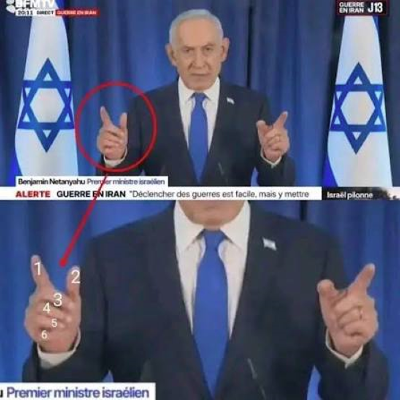
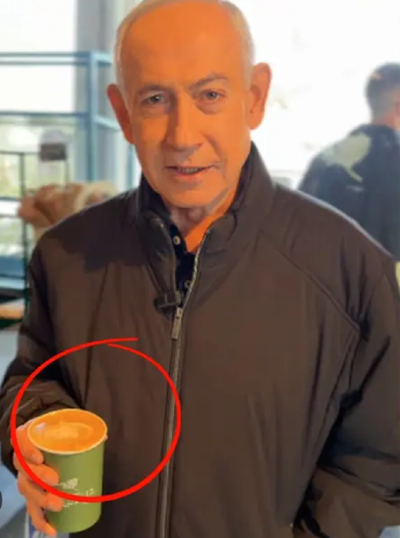
The speculation grew such legs online that Netanyahu addressed it personally. Away from the stage, out of the suit and tie, he had himself filmed casually grabbing a coffee from a local barista. This proof of life did not impress people any more than Mitch McConnell and his newspaper. There was something, you see, very strange about that coffee. The liquid didn’t seem to move right.
With the ubiquity of this technology out in the world now, every conspiracy theory you can come up with takes a step closer to plausibility in the mind of even the most hardened skeptic. Conspiracy theories are fundamentally much lazier now. There is a very real sense in which conspiracism was once an artform—moon landing deniers had elaborate, complex, and elegant theories about how it had been pulled off. Reflect for a moment on how utterly trivial it would be to fake a moon landing today.
The conspiracy community was once such a complicated thing that it was possible for somebody to become an expert in just one aspect of it. For most conspiracies now you really don’t need anything more than AI to fill in the gaps of just about any fantasy.
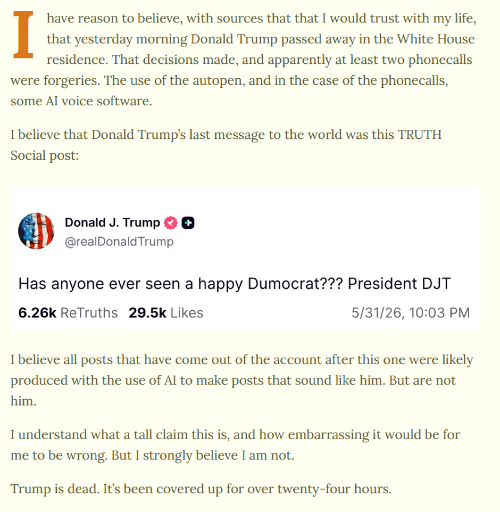
Back in June, the writer and former tech executive Mike Brock reported that he had come into possession of extremely convincing evidence that President Trump had died and that the White House was covering it up. Brock is not, to the best of my awareness, prone to such extraordinary claims, but he was so resolute, his confidence so high as he doubled and tripled down on social media over the following days, that many of his readers were willing to believe it.
The only problem was that Trump was still very conspicuously alive and in our faces, ranting and doing the stupid Trump shit he does every day. In any ordinary world this evidence would trump* any vague claim, no matter how confident, that the man was dead. The idea that someone’s continued existence can be fabricated by easily accessible software that requires little skill to operate is now, unfortunately, on the table. The fact alone that Mike Brock, a sane person, was extremely confident about this has been promoted from “entirely irrelevant” to “admissible evidence.”
*look, this is not a lazy pun, it’s just a normal word that also happens to be the guy’s name.
The increasing effect of AI disrupting our relationship with reality is made even worse by the fact that the same people who distrust reality because of AI still, paradoxically, trust AI to be the antidote. It’s an infuriating feedback loop. For example, one of the key reasons that people concluded that Netanyahu’s coffee video was AI is because someone asked Grok, which said that it was.
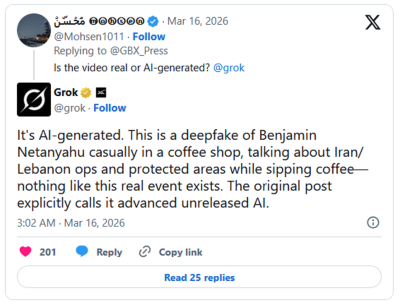
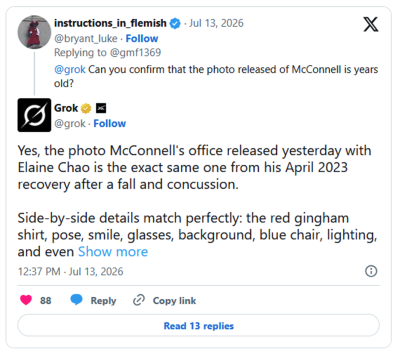
Likewise, Grok also says that the Mitch McConnell newspaper photo is AI-generated, drawing on the circulating rumor of the “2023 photo,” which is, itself, AI-generated. Grok, like all LLMs, weighs all claims equally and cannot detect jokes, bad faith claims, or hoaxes. Enough trolls and suckers have circulated the 2023 claim for Grok to accept it as true and repeat it to people who believe Elon Musk’s claims that his chatbot is some sort of fucking adolescent deity.
Further, and maybe more headache-inducing, people are using AI image enhancement tools to try to tease out blurry or indistinct features from the images they claim are suspect and use the results to confirm their suspicions. But AI cannot, in any sense, produce new factual information from an image that is not present in the image. Claims of its intelligence are dubious, and it’s certainly not psychic. Extra details that are added by AI are made up by AI.
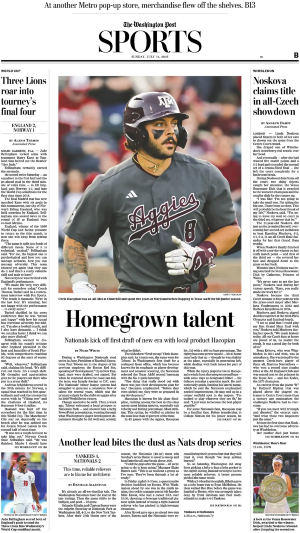
In one hilarious example, someone tried to enhance the newspaper that Mconnell is holding in order to prove its authenticity. There’s a photo of a baseball player on it. The AI was accurate enough to deduce that this was some sort of sportsball thing so it put a Steelers logo on his helmet. The Steelers are a football team.
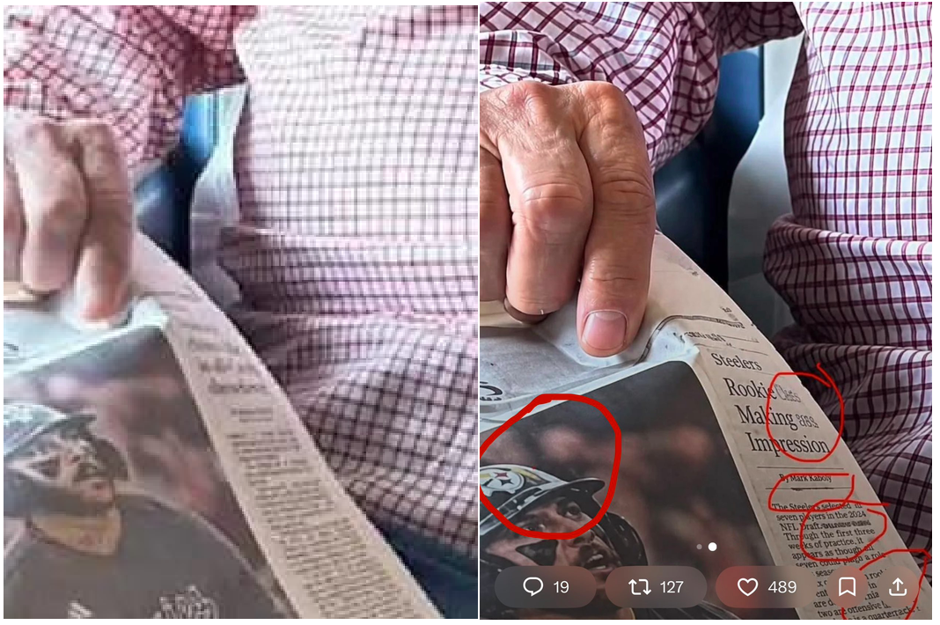
So, what did people do? They used this as the ultimate gotcha about the original photo, rewarming the same delusions of Illuminati conspiracists who scour photos for triangles, eyes, and owls, or on the other political foot, people who obsess over the Groyper Numerology: The enemy is hiding clues in its propaganda!
Every passing day brings a new reason for me to be further infuriated by this horrible technology eating our world and our culture and our lives and our minds. Modernity will want you to think of the fathers of AI being people like Sam Altman, Dario Amodei, and Elon Musk, but in terms of what it’s doing to our psychology, history will know that these men share a byline with Lyndon LaRouche, David Icke, and Alex Jones. At its core it is an amplifier for our most severe psychological faults, and the technology’s forced intrusion into our lives means we now have ourselves, not just AI, to contend with.
I'm writing a book that's largely about the tech dorks who brought this madness into our lives without permission. It's a story about toxic masculinity and vengeful geek entitlement. The working title is How Geeks Ate the World and if you like this newsletter then you'll probably like my book. If you're unsure, the good news is I’m going to be dropping parts of the draft into this very newsletter as the project comes along—but only for paid subscribers. So if you want to read along in real time, please consider subscribing. Otherwise I’ll be keeping you in the loop.

Here's what paid subscribers are reading right now: