🔒 What is Social Media to Do About Its Monsters?
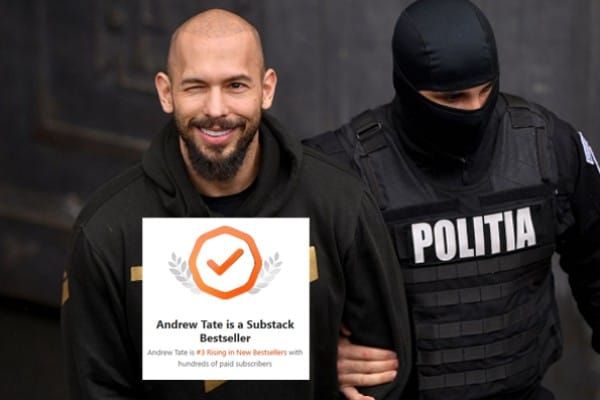
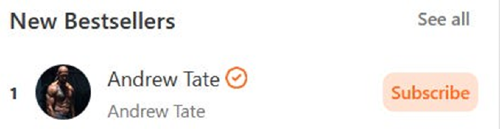
One thing that Substack and Bluesky have in common as social media platforms is that every so often a local controversy will pop off on one of them that the other will bang on about as another example about why they are great and that other place is an irredeemable shithole. The latest is that Substack’s promotional algorithm recently started recommending human melanoma Andrew Tate as one of its newest bestsellers.
Let’s get this out of the way so as to remove any seed of doubt as to my position on the critter known as Andrew Tate: This is one of the worst human beings currently alive. If you could run masculinity through an HVAC, Andrew Tate would be what you scraped off the filter after waiting too long to service it, wadded up and festering. It’s a failure of society that he’s walking free and a failure of humanity that he exists in the first place.
As usual, there are two factions reacting to this news: The “oh my god, how can this be allowed, do the owners actually support him, is it time to leave Substack?” faction, and the “this is healthy, stop pearl clutching, censorship is bad, censorship got us Trump” faction.
To the continued irritation of those on either side who can’t pin me down as either pro- or anti-Substack, I have both criticisms and defenses. But my defenses, which I will outline later, have little in common with the “stop pearl clutching!!” brigade, whose protests are usually a shallow cover for “if the platform cracks down on this, then my ubiquitous anti-woke screeds that I boldly label heterodox are surely next!”
If I have to tap this sign until my finger is worn down to an ivory nub, then I will: Declining to provide someone a soapbox isn’t censorship. Declining to promote someone isn’t censorship. Refusing to pay someone or profit from their views isn’t censorship. A community opposing someone’s views to such an extent that they don’t feel comfortable coming around these parts isn’t censorship.
With Andrew Tate, as it was with the whole Nazi newsletters thing that I won’t relitigate for the hundredth time, the real issue, whether people recognize it or not, is with promotion and profit. Tate simply using the infrastructure of the site doesn’t bother people as much as they might think, and you know how I know that? Because he’s actually been on Substack since September 2024. I don’t think anyone talking about this now even thought to look.
What made people actually notice he was there was that Substack briefly promoted him the other week in the “new bestsellers” sidebar of the browser version of the Notes social feature, which broadcast to everyone using the site that 1) he was there, and 2) he is making money from it, which means Substack is making money from him.
Now, I don’t know what the story is there—I guess he only just now turned on paid subscriptions? Actually, to be honest, I very much doubt Tate himself ever visits Substack or even knows what it is. I’m almost certain this is a social media manager that he’s paying to post his bullshit everywhere possible. Nevertheless, his content is there, it’s now monetized, and it’s getting lots of love from the algorithm.
I’m a very strong free speech guy, but in the sense of speech being what’s called a “negative legal freedom.” What that term means is simply that I don’t think it should be illegal to say or believe certain things. For example, in Queensland, Australia, it’s now literally illegal to say the phrase “from the river to the sea” in public and I think that’s disgraceful. For balance, I also think it would be disgraceful to make it illegal to advocate dropping a nuke on Gaza, and I use this as a hypothetical, because I don’t think that’s currently illegal anywhere. Make of that what you will.
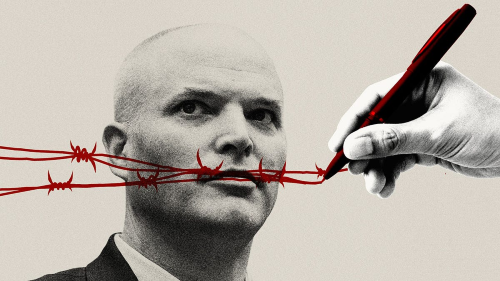
I think there should be a very high bar for defamation lawsuits. I support very strong journalistic freedom. I support very strong protections against SLAPP lawfare (weak but persistent lawsuits filed by corporations and billionaires against private citizens, not for the purpose of winning, but for intimidation and financial drain.) These beliefs put my free speech bona fides even above such free speech superheroes as Elon Musk and Matt Taibbi, who absolutely love SLAPP suits and silencing journalists.
However, I butt heads with people who have more wishy-washy and usually self-serving free speech beliefs that bleed into speech being more of a “negative universal freedom,” which would entail an absence of any kind of barrier to speech in public or private life. So, like, you can’t ban or shadowban or demonetize or algorithmically diminish someone from a social media site. These ideas often become hard to distinguish from what’s known as “positive freedom,” which would be the obligation to provide people with a platform and an audience.
This is all unfeasible nonsense that often relies on treating all speech as basically equal speech and any objection you have to what Andrew Tate peddles is tantamount to civil disagreement. Hard pass on that shit. Andrew Tate isn’t somebody you merely disagree with and I don’t think that being outraged and horrified by systematic and industrialized sexual abuse and sex trafficking can be easily reduced to pearl clutching.
For free subscribers, this is a preview. Free subscribers get access to this article on Friday 1-May