What is Social Media to Do About Its Monsters?
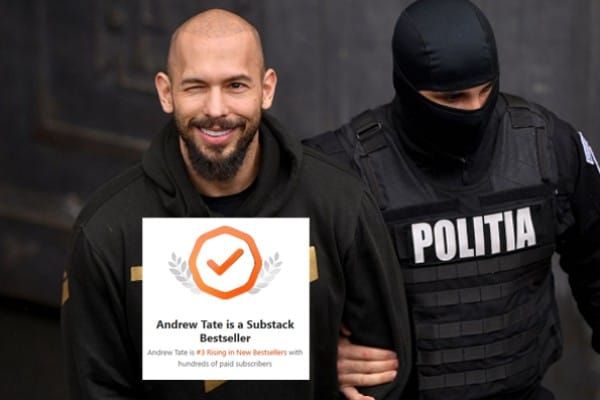
One thing that Substack and Bluesky have in common as social media platforms is that every so often a local controversy will pop off on one of them that the other will bang on about as another example about why they are great and that other place is an irredeemable shithole. The latest is that Substack’s promotional algorithm recently started recommending human melanoma Andrew Tate as one of its newest bestsellers.
Let’s get this out of the way so as to remove any seed of doubt as to my position on the critter known as Andrew Tate: This is one of the worst human beings currently alive. If you could run masculinity through an HVAC, Andrew Tate would be what you scraped off the filter after waiting too long to service it, wadded up and festering. It’s a failure of society that he’s walking free and a failure of humanity that he exists in the first place.
As usual, there are two factions reacting to this news: The “oh my god, how can this be allowed, do the owners actually support him, is it time to leave Substack?” faction, and the “this is healthy, stop pearl clutching, censorship is bad, censorship got us Trump” faction.
To the continued irritation of those on either side who can’t pin me down as either pro- or anti-Substack, I have both criticisms and defenses. But my defenses, which I will outline later, have little in common with the “stop pearl clutching!!” brigade, whose protests are usually a shallow cover for “if the platform cracks down on this, then my ubiquitous anti-woke screeds that I boldly label heterodox are surely next!”
If I have to tap this sign until my finger is worn down to an ivory nub, then I will: Declining to provide someone a soapbox isn’t censorship. Declining to promote someone isn’t censorship. Refusing to pay someone or profit from their views isn’t censorship. A community opposing someone’s views to such an extent that they don’t feel comfortable coming around these parts isn’t censorship.
With Andrew Tate, as it was with the whole Nazi newsletters thing that I won’t relitigate for the hundredth time, the real issue, whether people recognize it or not, is with promotion and profit. Tate simply using the infrastructure of the site doesn’t bother people as much as they might think, and you know how I know that? Because he’s actually been on Substack since September 2024. I don’t think anyone talking about this now even thought to look.
What made people actually notice he was there was that Substack briefly promoted him the other week in the “new bestsellers” sidebar of the browser version of the Notes social feature, which broadcast to everyone using the site that 1) he was there, and 2) he is making money from it, which means Substack is making money from him.
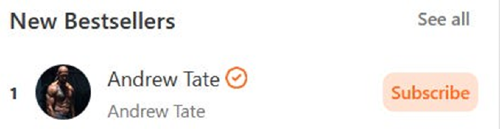
Now, I don’t know what the story is there—I guess he only just now turned on paid subscriptions? Actually, to be honest, I very much doubt Tate himself ever visits Substack or even knows what it is. I’m almost certain this is a social media manager that he’s paying to post his bullshit everywhere possible. Nevertheless, his content is there, it’s now monetized, and it’s getting lots of love from the algorithm.
I’m a very strong free speech guy, but in the sense of speech being what’s called a “negative legal freedom.” What that term means is simply that I don’t think it should be illegal to say or believe certain things. For example, in Queensland, Australia, it’s now literally illegal to say the phrase “from the river to the sea” in public and I think that’s disgraceful. For balance, I also think it would be disgraceful to make it illegal to advocate dropping a nuke on Gaza, and I use this as a hypothetical, because I don’t think that’s currently illegal anywhere. Make of that what you will.
I think there should be a very high bar for defamation lawsuits. I support very strong journalistic freedom. I support very strong protections against SLAPP lawfare (weak but persistent lawsuits filed by corporations and billionaires against private citizens, not for the purpose of winning, but for intimidation and financial drain.) These beliefs put my free speech bona fides even above such free speech superheroes as Elon Musk and Matt Taibbi, who absolutely love SLAPP suits and silencing journalists.
However, I butt heads with people who have more wishy-washy and usually self-serving free speech beliefs that bleed into speech being more of a “negative universal freedom,” which would entail an absence of any kind of barrier to speech in public or private life. So, like, you can’t ban or shadowban or demonetize or algorithmically diminish someone from a social media site. These ideas often become hard to distinguish from what’s known as “positive freedom,” which would be the obligation to provide people with a platform and an audience.
This is all unfeasible nonsense that often relies on treating all speech as basically equal speech and any objection you have to what Andrew Tate peddles is tantamount to civil disagreement. Hard pass on that shit. Andrew Tate isn’t somebody you merely disagree with and I don’t think that being outraged and horrified by systematic and industrialized sexual abuse and sex trafficking can be easily reduced to pearl clutching.
Twitter was obviously never a perfect platform but it worked, probably better than any social media platform extant today. It was pretty ruthless on people like Andrew Tate, Alex Jones, Nick Fuentes, and other sorts who advocated for extreme bigotry or misogyny, but it had a very complex moderation system that brought it close—the closest we’ve ever come, I think—to what I term a true ideological emulsion.
Those monsters didn’t get cast off the internet, they were free to go somewhere that would tolerate them, and they all did. They went to places like Gab and Rumble. In Donald Trump’s case, he simply built his own Twitter. On regular Twitter, though, they just weren’t welcome to advertise their garbage. They weren’t given access to an algorithm that would promote their sludge. Their bigotry was not rewarded with attention as the company didn’t believe rewarding bigotry was its sole purpose.
Twitter didn’t fail because it was unpopular. People, for some reason, characterize its death as being the result of an anti-censorship backlash reaching critical mass—the barbarians breaking through the gate. That’s not what happened. What happened was that a single multibillionaire brute forced it.
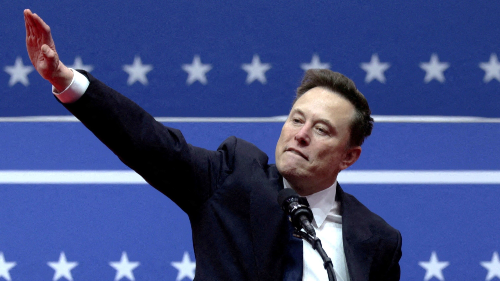
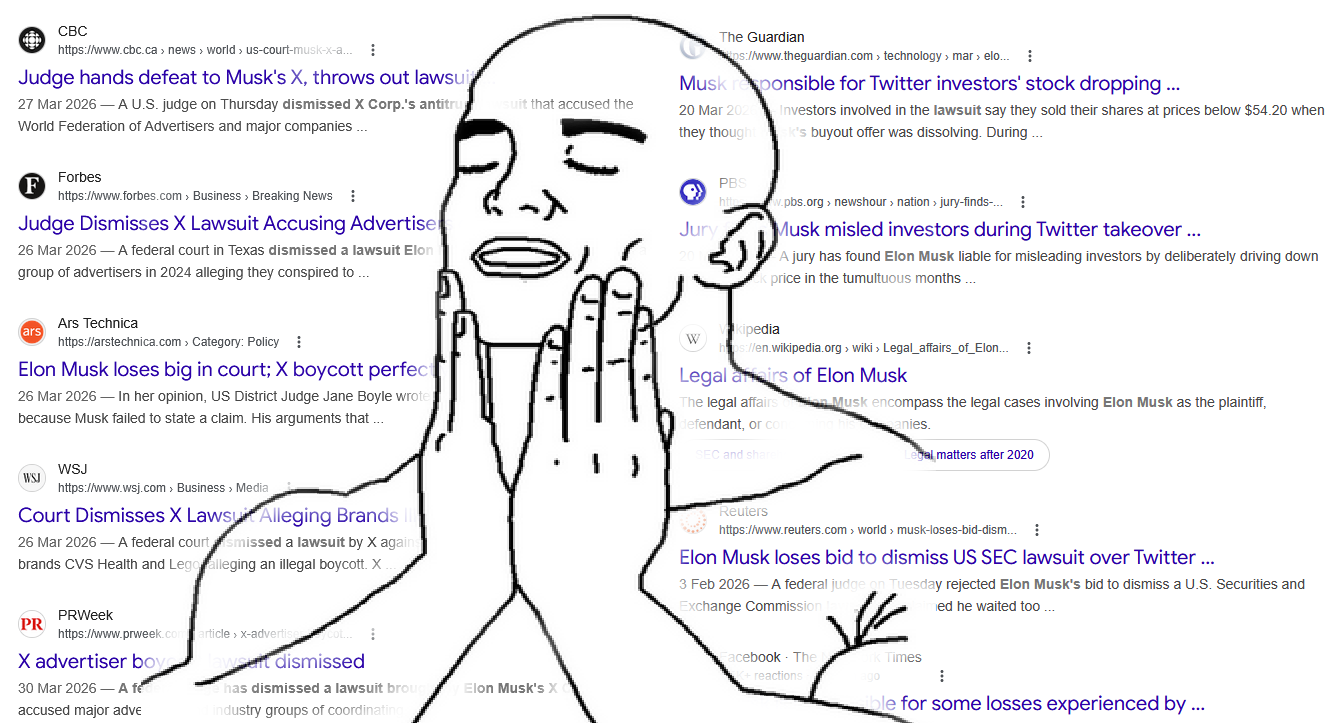
Elon Musk flooding the site with extremists and fringe far-right personalities is what broke the emulsion. Everyone else just started leaving, which is yet another thing—a form of boycott—that people like Elon Musk mislabeled as a form of censorship. People were violating his freedom of speech, a positive freedom apparently, by leaving his platform. He tried to sue people for it.
The fact that people will exercise their freedom of movement and leave a platform if it does nothing about bigotry is, as I have discussed at length before, simply descriptive. It isn’t prescriptive and, despite accusations to the contrary whenever I criticize Substack, I have never urged anyone to leave Substack. But a certain amount of people will just leave, and you can call them snowflakes or whatever else makes you feel better about yourself, but they will, and platforms need to make this calculus when figuring out exactly what kind of platform they want to be.
“But Sped, you said you were going to defend Substack here!”
Yeah, I will, I have to, because when all is said and done… what exactly is Substack supposed to do in this case?
Being just “ban Andrew Tate.” Because the next question is “by what criteria?” Being an incredibly shitty human being just in general can’t work here. I don’t know what is being posted to the Andrew Tate account—I looked! It’s almost entirely paywalled!—but what is accessible appears mostly to be vague motivational speeches over dramatic music. I haven’t seen anyone point to something he has specifically posted to Substack that breaks its rules.
You can say “but he’s Andrew Tate, nobody should be funding Andrew Tate or facilitating his ability to be funded,” and you would be, to me, obviously correct. However, in that case, get a pen and a notebook, because I have a list of a thousand other people on Substack who are following the rules but whose general existence is, I believe, a detriment to society. Therein lies our problem.
Social media platforms can hire moderators and build infrastructure to monitor and moderate their platforms, but what they cannot do is monitor the internet. Once the red line of “breaking the rules of the platform on the platform” expands to “breaking the rules of the platform anywhere else online or even offline,” then you’ve created an impossible scenario.
“You don’t have to monitor anything! Everyone knows Andrew Tate is a piece of shit!” True, but “everybody knows” can’t be a basis for this kind of thing. You ban Andrew Tate for his off-site behavior, even for something as egregious as sex trafficking or rape, and you get flooded with “Okay, but what about this guy, who calls people the N-word on Twitter? What about this person, who is viciously transphobic on Facebook? What about this guy, who I know from college, and can attest that he is a loud and proud Holocaust denier?”
Mike Masnick, the very long running editor and founder of Techdirt, has a firm stance that content moderation, at scale, is impossible to do well. You can read one of his essays about it here and I won’t recap it all, but suffice to say, effective social media moderation almost follows a kind of square-cube law by which its difficulty scales up faster than its userbase. Or, to put it another way, picture it like a Jenga tower. You know what happens to those as they get bigger.
I’ll give you another example, taken from Bluesky. Probably the most notorious moderation controversy on Bluesky is based on their refusal to ban a single individual. Or, should I say, a Singal individual.
Now, the war between journalist Jesse Singal and the transgender community is, I think, pretty well known and I’m not going to get into it all here—you can read GLAAD’s page on him here if you want. His Bluesky deadlock is such that it has actually made headlines in mainstream media in such a way that I’ve rarely seen when it comes to social media disputes against one person.
The issue on Bluesky is that it has an extremely robust trans population due to the fact that these were some of the first people to flee Twitter once the world’s most hardcore anti-trans activist (except maybe JKR) became its dictator CEO. The fact that Singal joined the platform, in an apparent effort to troll them, makes a lot of people feel very unsafe, and I don’t blame them.
But while I think he’s been a dickhead about this on Twitter, the problem is that he’s been a dickhead on Twitter. The position of the Bluesky moderators is simply that they don’t moderate Twitter. Any rebuttal to that just falls victim to the “but everyone knows” problem.
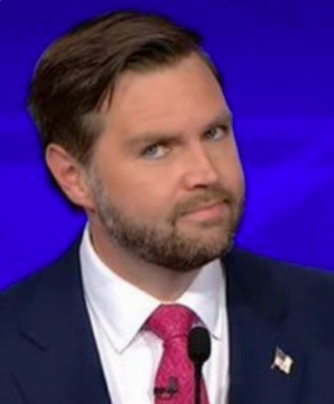
And the nightmare that would arise for Bluesky mods should they acquiesce and ban Singal for his Twitter dipshittery is already waiting in the wings clearly to be seen. In October of last year, the Trump administration flooded Bluesky with official government accounts, including vice president JD Vance, again in an obvious effort to troll. There was an instant rush of demands for Bluesky to ban all of these accounts because we shouldn’t have fascists on Bluesky. Likewise, there have been intermittent demands to ban Neil Gaiman after his sexual abuse allegations came out, but that was 2024 and he hasn’t posted since then.
In all these cases the demands have been to, more or less, moderate based on vibes. I’m not equating Jesse Singal with Andrew Tate, but presumably the only reason Tate isn’t on Bluesky is that his whole entire thing is making money and sexually abusing women, and he doesn’t really have a path to either of those things on Bluesky. But if he did, and he followed the rules, then by what metric could he be banned?
This isn’t just a social media thing, either. To some extent it’s universal. You could be banned from Costco for licking the rotisserie chickens and putting them back in the bag, but could you be banned from Costco for being Andrew Tate?
I was a forum admin for many years on the old comedy website David Wong’s Pointless Waste of Time, which later became Cracked. And I know this kind of thing used to be a lot easier, when the internet was broken up into thousands of small communities. On PWOT, if someone was a huge dipshit, you could just ban them. We banned Nazis on sight, we banned incels, we banned racists, we just banned pricks, it wasn’t any kind of big deal, they would just go back to Something Awful or Stormfront or 4chan or wherever and keep free speeching to their heart’s content. It kept our little community fun. After Cracked got big, and then huge, and the rest of the internet started to coalesce into just a few big social media blobs, we started to realize that we couldn’t moderate on vibes anymore. We had to operate strictly by the book.
Now that the social internet is something like five websites, I don’t wish the job of content moderation on my worst enemy. As critical as I am of social media platforms, this is one thing I kind of have to take their side on. Deal with it however you wish—block the assholes, leave the platforms if you feel you need to, or just close your eyes and repeat the mantra “there is no ethical consumption.” In any case, unfortunately, the monsters are probably sticking around.
I'm writing a book about where all these monsters came from in the first place and how reactionary interpretations of free speech, liberty, and masculinity seeped out of internet culture to affect our offline lives. The working title is How Geeks Ate the World and if you like this newsletter then you'll probably like my book. If you're unsure, the good news is I’m going to be dropping parts of the draft into this very newsletter as the project comes along—but only for paid subscribers. So if you want to read along in real time, please consider subscribing. Otherwise I’ll be keeping you in the loop. Check it out here!