🔒 Why You Can't Treat Online Communities Like Offline Communities

I don't like talking about Substack much because a lot of my Ghost audience subscribes specifically to get away from Substack, and I hear you. But part of my beat is talking about online communities and, for this week's topic, Substack just happens to be my case in point. It's not a unique phenomenon to that platform.
On June 3rd a Substack writer named Robert M. Hamburger—who had, at the time, a few hundred subscribers, and whose pieces average somewhere between ten and thirty likes—published a piece that was liked over five thousand times with over two thousand reshares. A spectacular hit that went more viral than probably anything I’ve ever seen on the platform.

It’s titled “An Open Letter to Chris Best, CEO of Substack.” Its immense irony is a brutalist work of art.
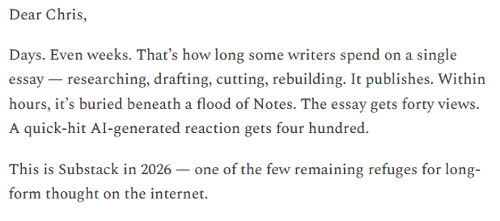
First of all, it’s very obviously AI generated. The very first line is the exact type of wistfully condescending hack prose that ChatGPT or Claude always spits out when you ask it to compile some kind of manifesto: “Days. Even weeks. That’s how long some writers spend on a single essay — researching, drafting, cutting, rebuilding.”
It’s a style—if one regards the algorithmic average of all amateur writing, both underwritten and overwritten, smoothed into a homogeneously sterile medium-written block of words to be a style—that flows through the entire essay. The first irony smacks you when you read a little further and discover that this thing is a tirade against AI.
If you read the whole thing—it’s short and thinly written, which helps with virality—the ironies compound. It’s not just a tirade against AI. It’s a complaint partly that short and thinly-written AI generated content is drowning everything out and going viral at authentic newsletters’ expense, and partly that the addition of a Twitter-style social media feed at Substack’s home page has turned essay writing and discoverability into an exercise at gaming the algorithm much more than quality writing.
It’s tempting to believe that Robert Hamburger is a genius who deliberately wrote a self-proving thesis. I don’t think that’s true. I suspect he’s being earnest and thinks that his usage of AI doesn’t detract from the broader point that he prompted it to espouse. Amusingly, after Chris Best responded to the piece by simply pointing out it was AI generated, another writer came to his defense by arguing for its authenticity and attacking, at length, the legitimacy and accuracy of AI detection tools. Hamburger responded to this, shooting his own defender down in flames, with an admission that he actually did use AI, in a note that was also obviously generated by AI.
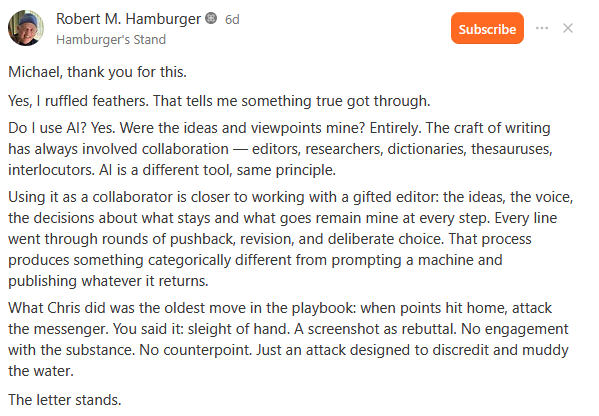
Okay so he can’t write without AI. Sadly, a lot of people can’t anymore, so let’s drop that for now. The important thing is that several thousand people agree with ChatGPT or Claude or maybe Grok’s interpretation of Hamburger’s actual point, here. So, is Hamburger actually right?
The answer is yes, in some ways, but not exactly in the way I think he realized.
I don’t often write about Substack. I’ve published over 150 pieces to that platform now and maybe 10-15 of them have referenced the platform itself and its community. But I’m looking now at the most popular pieces I’ve ever written in order, in terms of views and engagement: Of the top ten pieces, six are entirely or largely about Substack. (The links here point to the Ghost mirrors of these pieces, if you don't want to give the site traffic) That’s the most popular, the second most popular, the fourth, the sixth, the seventh, and the tenth. Special credit to the thirteenth most popular, which is also entirely about Substack.

I don’t count many of these among my best pieces, but it does seem to be the case that, if you write about Substack on Substack, it rips through the algorithm like fire through the Palisades. It doesn’t seem to matter if you’re complaining about Substack as long as you’re talking about it.
The Substack algorithm is a black box, as are most social media algorithms. They’re not going to tell us how this all works. The question is: Is the fact that posts about Substack do really well on Substack due to an algorithmic pressure that pushes Substack-related content? Or does Substack-related content overpower the algorithm because people just share it so enthusiastically?
I think I would be surprised if Substack didn’t algorithmically entice people to talk about the platform itself, but the result, whether forced or organic, is the same: Substack strongly considers itself a community, and people have strong thoughts about their communities.
For free subscribers, this is a preview. Free subscribers get access to this article on Friday 19-June